
The signal
I have been dealing with the same ChatGPT consistency problem for a while.
Not in casual prompts.
In real project work: product design, operating docs, workflows, product decisions, naming, and taxonomy.
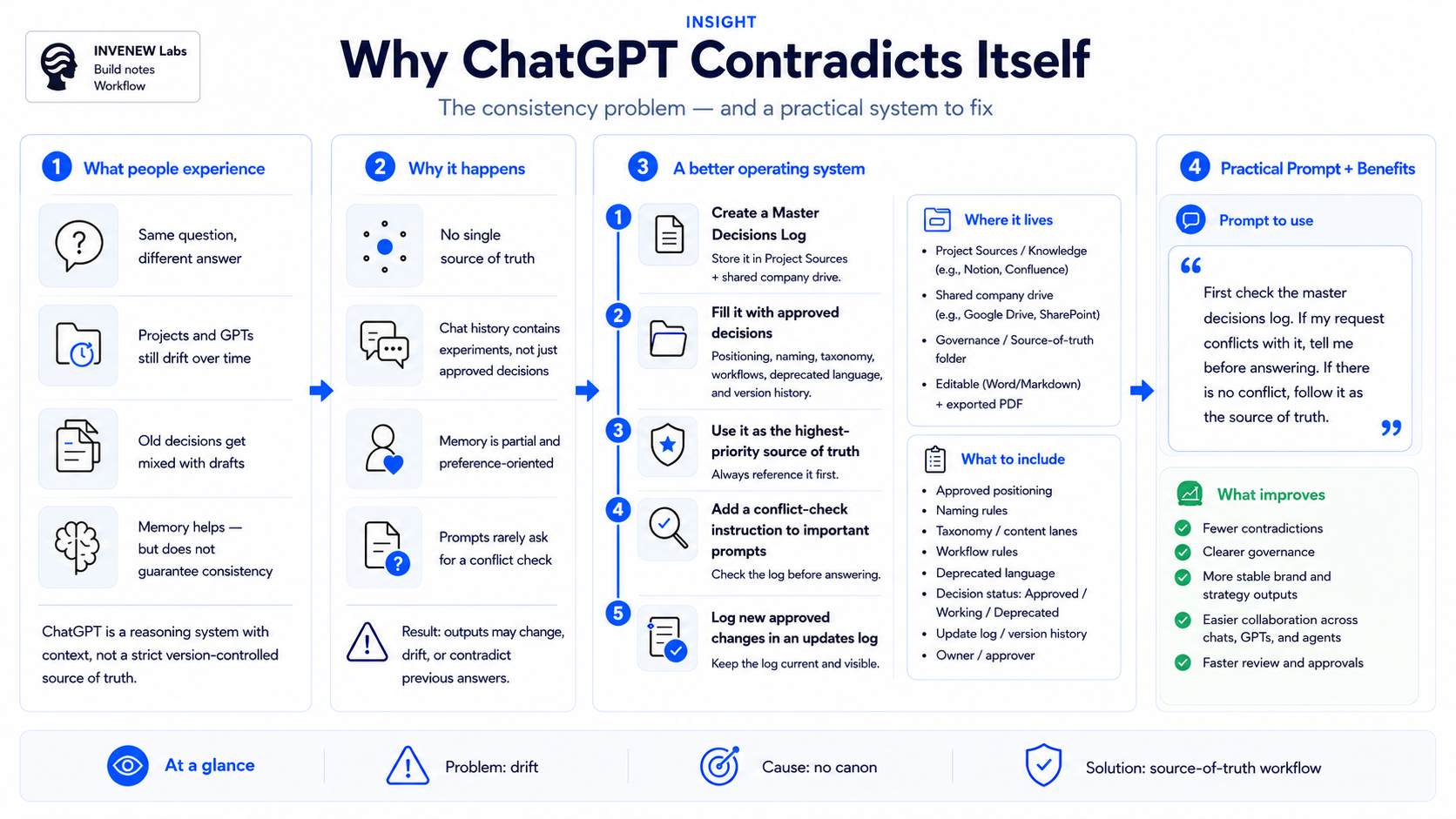
The pattern was subtle. I would ask a similar question in different chats, ChatGPT Projects, or Custom GPTs. The answers were usually not wildly wrong. That was the problem. They were close enough to sound useful, but different enough to create drift.
One answer nudged a product idea in one direction. Another slightly changed the naming. Another softened a workflow rule. Another rephrased website positioning in a way that looked harmless but moved away from an approved decision.
Why it matters
This becomes a real operating problem when AI is part of daily business work.
Small contradictions can spread quickly. A slightly different phrase can end up in a document. A softened decision can enter a prompt. A naming variation can appear in a content calendar. A workflow exception can become a new “rule” without anyone approving it.
Over time, the issue is not one bad answer. It is accumulated drift across product, content, operations, and strategy.
What is really happening
Memory, Projects, and Custom GPTs improve context. They help ChatGPT stay closer to the work.
But they do not automatically behave like a strict, version-controlled governance layer.
Chat history often contains experiments, drafts, rejected options, old language, and approved decisions sitting side by side. Unless the approved canon is clearly separated, the model may reason from all of it.
ChatGPT is a reasoning system with context. It is not, by itself, a source-of-truth system.
The operating fix
The fix is not just “use memory better.”
The fix is to create one approved source of truth that ChatGPT must check before doing important work.
For YourProject, create a Master Decisions Log.
Recommended setup
Create one editable file:
File name: YourProject_Master_Decisions_Log_v1.docx
Export copy: YourProject_Master_Decisions_Log_v1.pdf
Project location: YourProject → Sources
Storage location: OneDrive → Business-Documents → Governance_and_Source_of_Truth
Used by: ChatGPT Project YourProject, Chief of Staff GPT, Writer GPT, etc.
The Word version is the editable source.
The PDF version is the clean reference copy uploaded into the ChatGPT Project Sources.
What goes inside
The log should contain only approved decisions, not brainstorms.
Example sections:
Approved positioning
Approved audience language
Approved product direction
Approved brand and naming rules
Approved taxonomy
Approved content lanes
Approved publishing workflow
Approved website language
Deprecated phrases
Version history
Owner / approver
Date of last update
Example decision entry
Decision area: Brand positioning
Status: Approved
Decision: YourProject helps its target audience solve a specific problem with a clear product, service, or operating system.
Use this language: Approved audience terms, approved product language, approved positioning phrases.
Avoid: Deprecated phrases, outdated positioning, internal brainstorm language, and unsupported claims.
Approved by: Project owner
Date: YYYY-MM-DD
Notes: Use this across website copy, social posts, newsletters, articles, product docs, and internal workflows.
How to use it with ChatGPT
Before asking ChatGPT to create anything important, add this instruction:
“First check YourProject_Master_Decisions_Log_v1. Treat it as the highest-priority source of truth. If my request conflicts with an approved decision, tell me before drafting. If there is no conflict, follow the log.”
Example prompt
“Using the YourProject sources, draft today’s LinkedIn post. First check YourProject_Master_Decisions_Log_v1. Do not contradict approved positioning, naming, taxonomy, audience language, publishing workflow, or deprecated language. If anything conflicts, flag it before drafting.”
Why this works
– Memory gives ChatGPT context.
– Projects give ChatGPT workspace continuity.
– Custom GPTs give ChatGPT role behavior.
But the Master Decisions Log gives the system governance!
That is what prevents AI-generated product design, operating docs, publishing workflows, website copy, brand decisions, naming, and taxonomy from drifting over time.
Before your next important AI-generated draft, ask: “What approved decision should this output not contradict?”
INVENEW exists to help tech builders, operators, founders, and leaders turn AI from experiments into working systems.

Sponsored: In partnership with AWS