
The signal
Most AI conversations still start with the model.
Which model is best?
How big is it?
How does it benchmark?
Is it cheaper than the last one?
But the model is only one component.
AI infrastructure is everything underneath the application that lets models train, serve, scale, route, retrieve context, stay observable, and run at a cost the business can live with.
For builders, this matters because many AI apps do not fail because the model is weak.
They fail because the system around the model is weak.
Latency was not planned for.
Inference costs ran away.
The serving layer could not scale.
The data layer did not provide the right context.
The agent had no audit trail.
No one could explain what happened when something broke.
That is the real infrastructure problem.
The stack, simplified
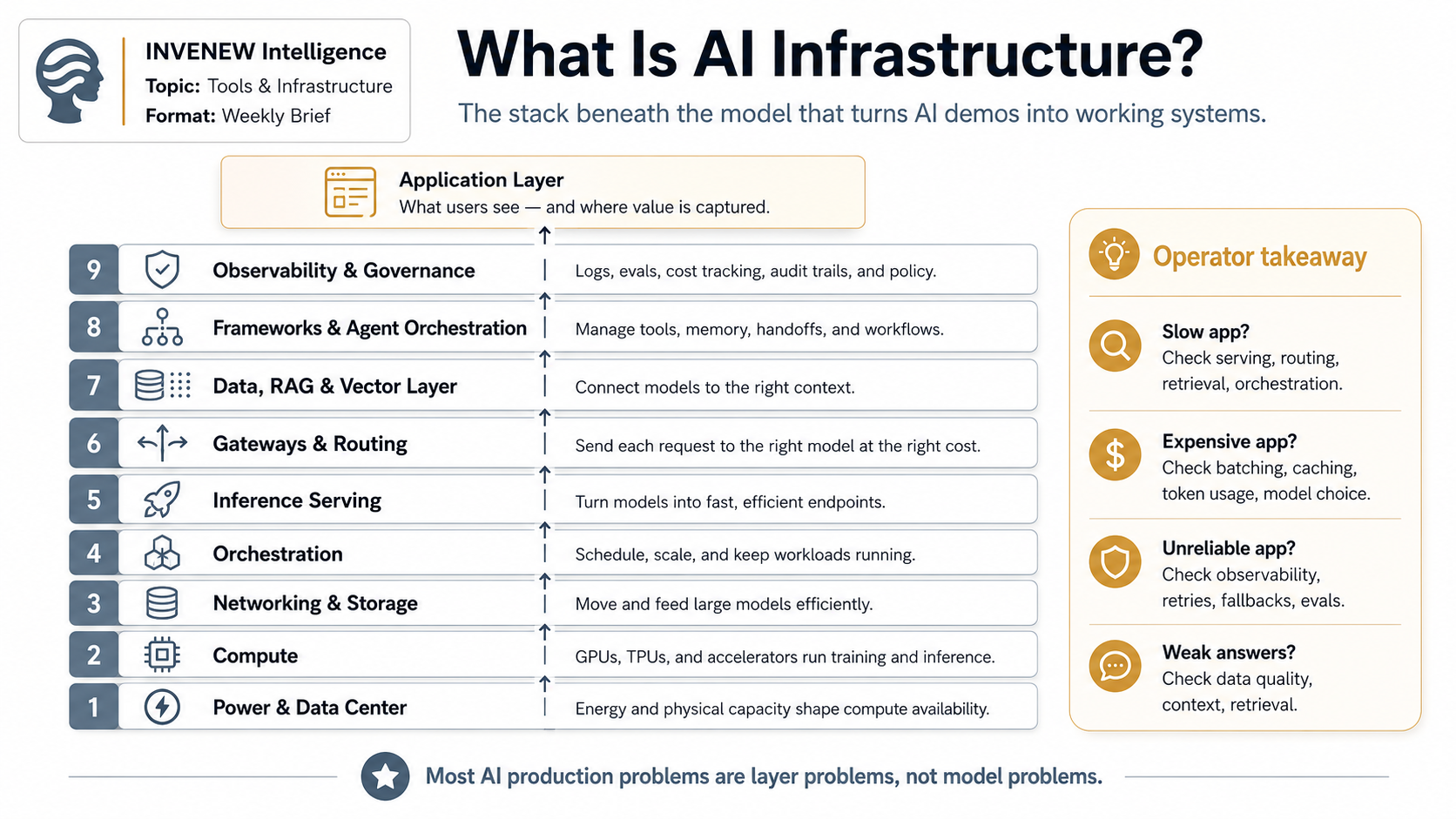
Think of AI infrastructure as a stack that runs from physical power all the way up to the user-facing application.
At the bottom is power and data centers. This is the unglamorous floor of the AI economy. Energy availability increasingly shapes GPU supply, compute pricing, and where AI capacity can actually be built.
Above that is compute: GPUs, TPUs, accelerators, and custom silicon. This is where training and inference happen. The right choice depends less on the headline chip and more on the workload: training, inference, latency, throughput, memory, and cost.
Then comes networking and storage. At scale, slow storage or poor network design can become the bottleneck. Model weights are large. Data movement matters. Throughput is not just a GPU problem.
Next is orchestration. Kubernetes and related systems schedule workloads, scale them, restart them, and keep services running across nodes. This is where “it works on one GPU” becomes “it can serve real users.”
Then comes inference serving. This is the layer that turns a trained model into a usable endpoint. Serving engines such as vLLM, KServe, and related stacks handle batching, caching, and GPU utilization. For builders, this is one of the biggest cost levers.
Above that is model routing and gateways. Once you use more than one model, the problem changes. The question is no longer “how do we call an LLM?” It becomes “which model should handle this request, under which policy, at what cost?” Gateways and routing layers are becoming the control point for cost, safety, fallback, and provider flexibility.
Then comes data, RAG, and context. This includes embeddings, vector databases, pipelines, retrieval logic, and the systems that connect models to your own data. Many AI failures are really context failures.
Above that are frameworks and agent orchestration. This is where agents, tools, memory, handoffs, roles, and protocols live. It is also where a lot of today’s innovation — and instability — sits.
Across all of it is observability and governance: logs, traces, evals, cost tracking, access control, audit trails, data lineage, and policy enforcement.
For serious AI systems, this is not phase two.
It is how you operate.
Why it matters now
Three shifts are making AI infrastructure harder to ignore.
First, agents change the load.
A chatbot may produce one response.
An agent may trigger a chain: retrieve data, call tools, write state, ask another model, retry, escalate, summarize, and log the result.
That is a very different infrastructure pattern.
Second, the control point is moving up.
Model choice is becoming more dynamic. Teams will increasingly route routine work to cheaper models and reserve frontier models for tasks that truly need reasoning.
That makes gateways, routing, and policy layers more important.
Third, governance is becoming part of the stack.
For AI systems, especially agentic systems, teams need to know what happened, which tools were called, which data was used, what changed, and whether the action can be replayed or audited.
You cannot operate what you cannot see.
The operator takeaway
The most useful question is not:
“Which model should we use?”
It is:
“Which layer is constraining the system?”
If the app is slow, look at serving, routing, retrieval, and orchestration.
If the app is expensive, look at model selection, batching, caching, token usage, and provider routing.
If the app is unreliable, look at observability, retries, fallback logic, evals, and deployment design.
If the app gives weak answers, look at data quality, retrieval, context, and workflow design.
Most AI infrastructure problems are layer problems.
Map the application to the stack. Find the constraint. Fix that layer first.
That is the difference between a demo and a working system.
Open question
As gateways and routing absorb more cost control, safety logic, and model-selection decisions, does the model become the commodity layer — and does the routing/governance layer become the real moat?
Worth watching where the durable value settles.
INVENEW exists to help tech builders, operators, founders, and leaders turn AI from experiments into working systems.

Sponsored: In partnership with AWS