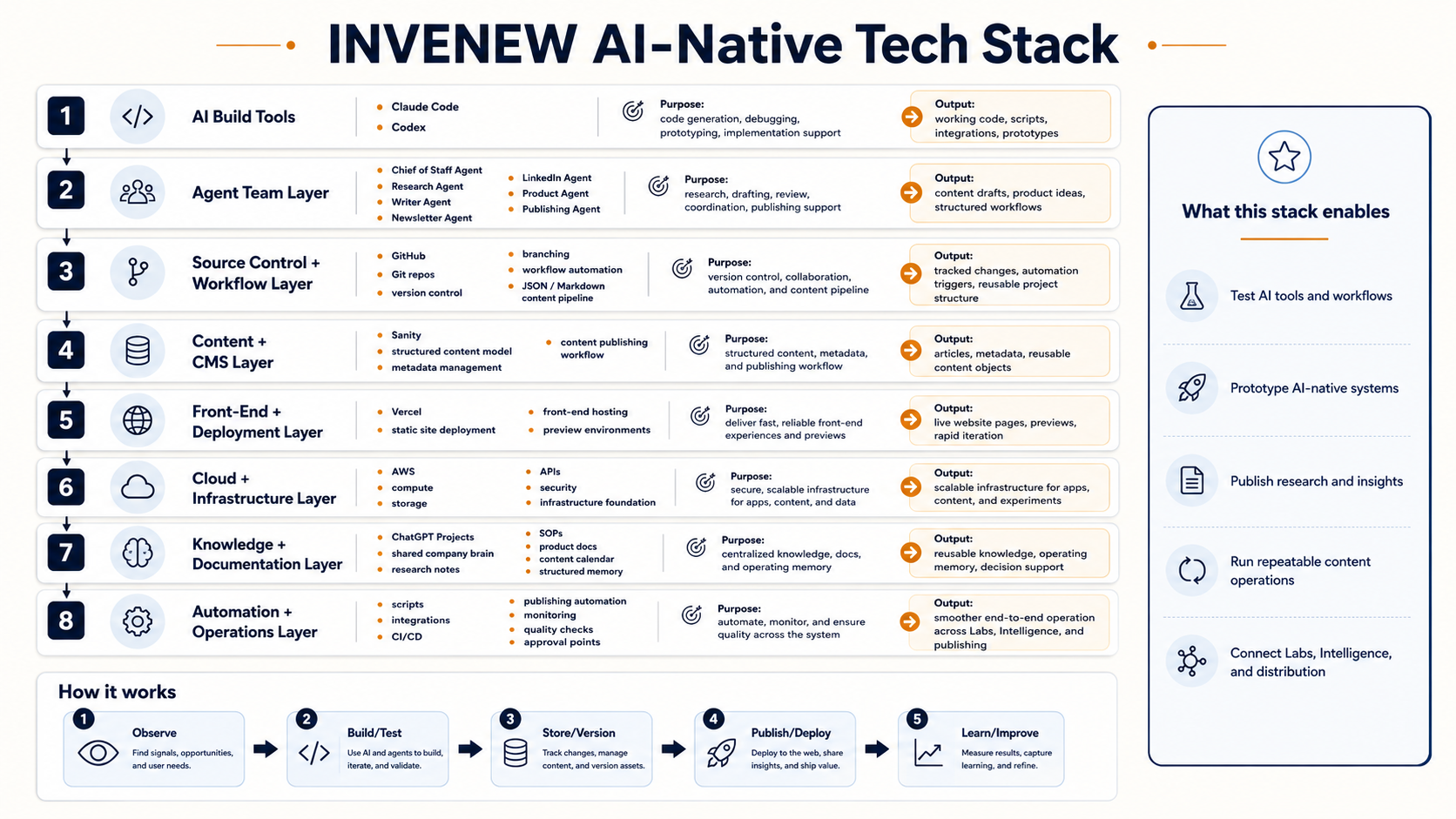

AI is becoming part of how people build software, run operations, publish content, manage knowledge, create products, and design new companies.
But there is still a large gap between trying AI tools and turning AI into working systems.
That gap is where INVENEW is focused.
INVENEW is being built as a research-led AI-native media and product platform for operators, builders, founders, product teams, consultants, SMBs, startups, and leaders who want to understand how AI works in the real world.
The goal is simple:
Help people turn AI from experiments into working systems.
The Two Arms of INVENEW
INVENEW has two connected arms:
INVENEW Labs tests what works.
Labs is the applied research and prototyping side. It explores AI tools, agent workflows, AI-native infrastructure, publishing systems, automation patterns, benchmarks, reference architectures, and practical operating models.
Labs is where ideas are tested.
Not as theory.
As working systems, prototypes, experiments, workflows, and reusable outputs.
INVENEW Intelligence explains what matters.
Intelligence turns what we learn into practical briefings, insights, explainers, playbooks, and research notes for people doing real work.
The goal is not to cover every AI headline.
The goal is to explain the signals that matter:
– What is useful.
– What is changing.
– What is ready.
– What is risky.
– What operators should watch.
– What builders can apply.
– What founders can turn into products.
A simple way to think about it:
– INVENEW Labs tests what works.
– INVENEW Intelligence explains what it means.
– INVENEW Briefing tells operators what to act on this week.
What INVENEW Will Focus On
The work will center around seven practical areas:
– AI Agents
– AI in Production
– Tools & Infrastructure
– SaaS Operations
– DataOps & Observability
– Strategy & Adoption
– Governance & Risk
These are not abstract categories.
They are the operating layers behind the next generation of AI-native work.
– How agents are designed.
– How workflows are automated.
– How AI tools connect to real infrastructure.
– How teams manage quality, risk, cost, and reliability.
– How knowledge turns into repeatable systems.
– How content, software, and products can be built faster without losing judgment.
That is the territory INVENEW will explore.
Today’s Founder Note
I also shared a short LinkedIn post today about what I am learning while setting up the INVENEW stack.
The early lesson is clear:
The tools are not the hard part.
The integration is.
– Claude Code can help build.
– Codex can help reason through implementation.
– GitHub can manage code and workflows.
– Sanity can structure content.
– Vercel can deploy quickly.
– AWS can support deeper infrastructure.
– ChatGPT and Custom GPT agents can support research, writing, product thinking, and publishing operations.
Each tool is useful on its own.
But the real work starts when they need to behave like one coherent system.
That is where small things become big things:
– File paths.
– Naming conventions.
– Schemas.
– Metadata.
– Workflow triggers.
– Environment variables.
– Human approval points.
– Agent roles.
– Version control.
– Publishing rules.
This is what many AI conversations miss.
AI-native work is not just about using better tools.
It is about designing a system where tools, agents, content, code, data, and human judgment can move together without creating chaos.
The future may look automated.
But underneath, it still needs architecture.
Why This Matters
Many teams are currently experimenting with AI.
Few have turned those experiments into durable systems.
The next wave of advantage will not come only from using the newest model or tool.
It will come from knowing how to connect tools, workflows, people, data, infrastructure, and decision points into systems that actually work.
That is the work INVENEW is being built around.
More to come from Labs, Intelligence, and the weekly Briefing.