
Most AI conversations start with tools.
Which model should we use?
Which agent framework is best?
Should we use ChatGPT, Claude, Gemini, Cursor, Windsurf, MCP, n8n, Zapier, or something else?
Those questions matter.
But they're not the most important question.
The more important question is:
How do all of these tools work together?
Because the reality is simple:
A collection of tools is not a system.
And a system is where the value gets created.
The Problem With Most AI Stacks
Many teams build what looks like an AI stack.
They have:
ChatGPT for writing
Claude for analysis
Notion for documentation
Slack for communication
Zapier for automation
A dozen SaaS tools
A growing list of prompts
On paper, it looks impressive.
In practice, work is still fragmented.
Knowledge is scattered.
Processes live inside people's heads.
Every project starts from scratch.
The organization becomes more dependent on tools without becoming more effective.
The problem isn't the technology.
The problem is the lack of a system.
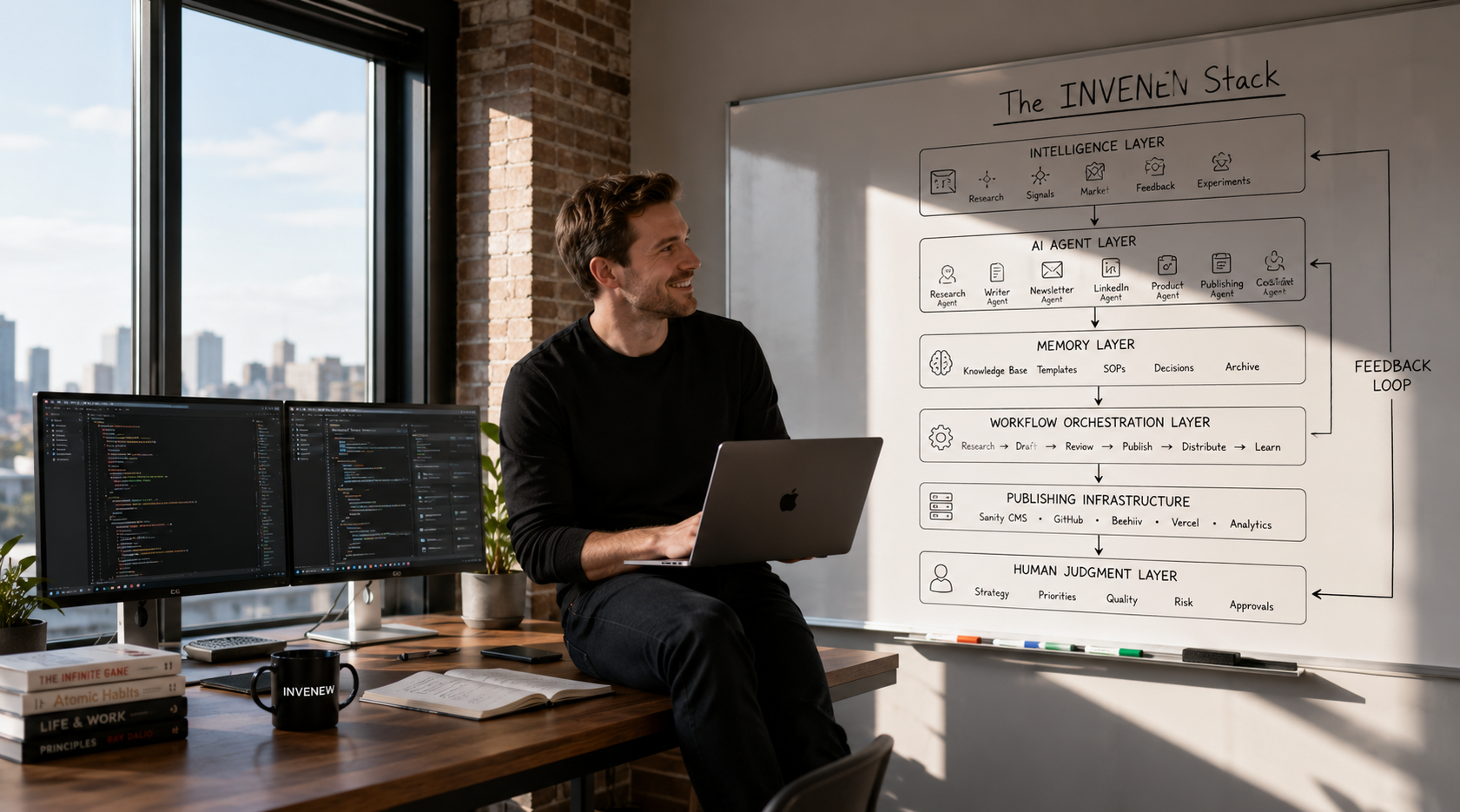
What Is the INVENEW Stack?
The INVENEW stack is not a list of software.
It's an operating model.
Every layer exists for a specific reason.
Every tool has a defined role.
Every output moves through a workflow.
Instead of asking:
"What can this tool do?"
We ask:
"What role does this tool play in the system?"
Layer 1: Intelligence
Every system starts with information.
Signals come from:
Market developments
Product launches
Research papers
Customer conversations
Community discussions
Internal experiments
The goal isn't collecting information.
The goal is turning information into usable intelligence.
Without this layer, organizations react to noise instead of understanding signals.
Output: Research notes, observations, opportunities, hypotheses.
Layer 2: AI Agents
Once intelligence enters the system, specialized agents take over.
At INVENEW, agents have jobs.
Not personalities.
Not vague responsibilities.
Specific jobs.
Examples include:
Research Agent
Writer Agent
Newsletter Agent
LinkedIn Agent
Product Agent
Publishing Agent
Chief of Staff Agent
Each agent owns a defined part of the workflow.
This creates consistency, accountability, and repeatability.
Most organizations underestimate memory.
They focus on generation.
The advantage comes from accumulation.
A system improves when it remembers:
Decisions
Frameworks
Experiments
Templates
Processes
Results
Without memory, every workflow resets to zero.
With memory, every workflow starts from experience.
The system becomes smarter over time.
Layer 4: Workflow Orchestration
This is where individual tasks become a process.
Research becomes a draft.
A draft becomes an article.
An article becomes a newsletter.
A newsletter becomes LinkedIn content.
A LinkedIn post generates audience feedback.
Audience feedback creates new research opportunities.
The output of one stage becomes the input of the next.
This is how systems compound.
Layer 5: Publishing Infrastructure
Content that never reaches people creates no value.
Publishing is not an afterthought.
It's part of the operating system.
At INVENEW, publishing includes:
Website infrastructure
CMS workflows
Newsletter distribution
Metadata management
Version control
Content archives
The objective is simple:
Move high-quality work from idea to publication with minimal friction.
Layer 6: Human Judgment
This is the most important layer.
Every AI-native organization still needs humans.
Humans decide:
Strategy
Priorities
Quality standards
Brand positioning
Risk tolerance
Final approvals
AI increases leverage.
Humans provide direction.
The organizations that understand this distinction will outperform those that don't.
How The Stack Works Together
The value doesn't come from any individual tool.
The value comes from the connections.
Research informs agents.
Agents create outputs.
Outputs flow through workflows.
Workflows feed publishing systems.
Publishing generates audience feedback.
Feedback creates new intelligence.
The entire system becomes a continuous learning loop.
This is why replacing one tool rarely changes outcomes.
The operating system matters more than the software running inside it.
The Future Is Not More Tools
Every week, new AI products launch.
Every month, new frameworks appear.
Every quarter, the stack changes.
That's normal.
Tools evolve.
Operating systems endure.
Organizations that focus only on tools will constantly rebuild.
Organizations that build systems can swap tools without breaking workflows.
That's the difference between experimentation and operation.
Operator Takeaway
Look at your current AI stack.
List every tool your team uses.
Then ask three questions:
What role does each tool play?
How does information move between them?
What happens when a person leaves?
If those answers aren't clear, you don't have a system yet.
You have software.
And software alone is not a strategy.
The best AI stacks are invisible.
People don't notice the tools.
They notice the outcomes.
That's when tools stop being tools.
That's when they become a system.
INVENEW exists to help operators, builders, founders, and leaders turn AI from experiments into working systems.