Free weekly AI engineering sessions taught by real instructors. Not for beginners. Every Wednesday at 5 PM CT. See upcoming sessions. Browse Free Sessions

The signal
Most AI conversations still start with models.
Which model is best?
Which benchmark is higher?
Which reasoning model is smarter?
Which open-source model is catching up?
Those questions matter. But they do not explain why some AI products work reliably in production while others become slow, expensive, brittle, or hard to scale.
The missing layer is compute.
AI compute is the physical and operational foundation that lets models train, fine-tune, serve, retrieve, reason, generate, and run inside real workflows.
A model may be the intelligence layer.
Compute is the capacity layer.
And production AI is now forcing builders to ask a more practical question:
Can we get the right compute, at the right cost, with the right memory, networking, latency, reliability, and operational control?
That question is becoming one of the most important questions in AI infrastructure.
AI compute is bigger than GPUs
When people say “AI compute,” they often mean GPUs.
That is understandable. GPUs have become the visible symbol of the AI boom. But production AI compute is not just one chip type.
It includes:
Cloud vendor capacity
GPU and accelerator servers
CPUs for orchestration and application logic
Custom AI chips
Memory capacity and bandwidth
High-speed networking
Storage throughput
Compute clusters
Model-serving runtimes
Scheduling and orchestration
Observability and cost controls
Power and cooling
The important shift is this:
AI compute is no longer only about raw performance. It is about useful output per dollar, per watt, per second, and per operational risk.
That is why teams need to think about compute as architecture, not procurement.
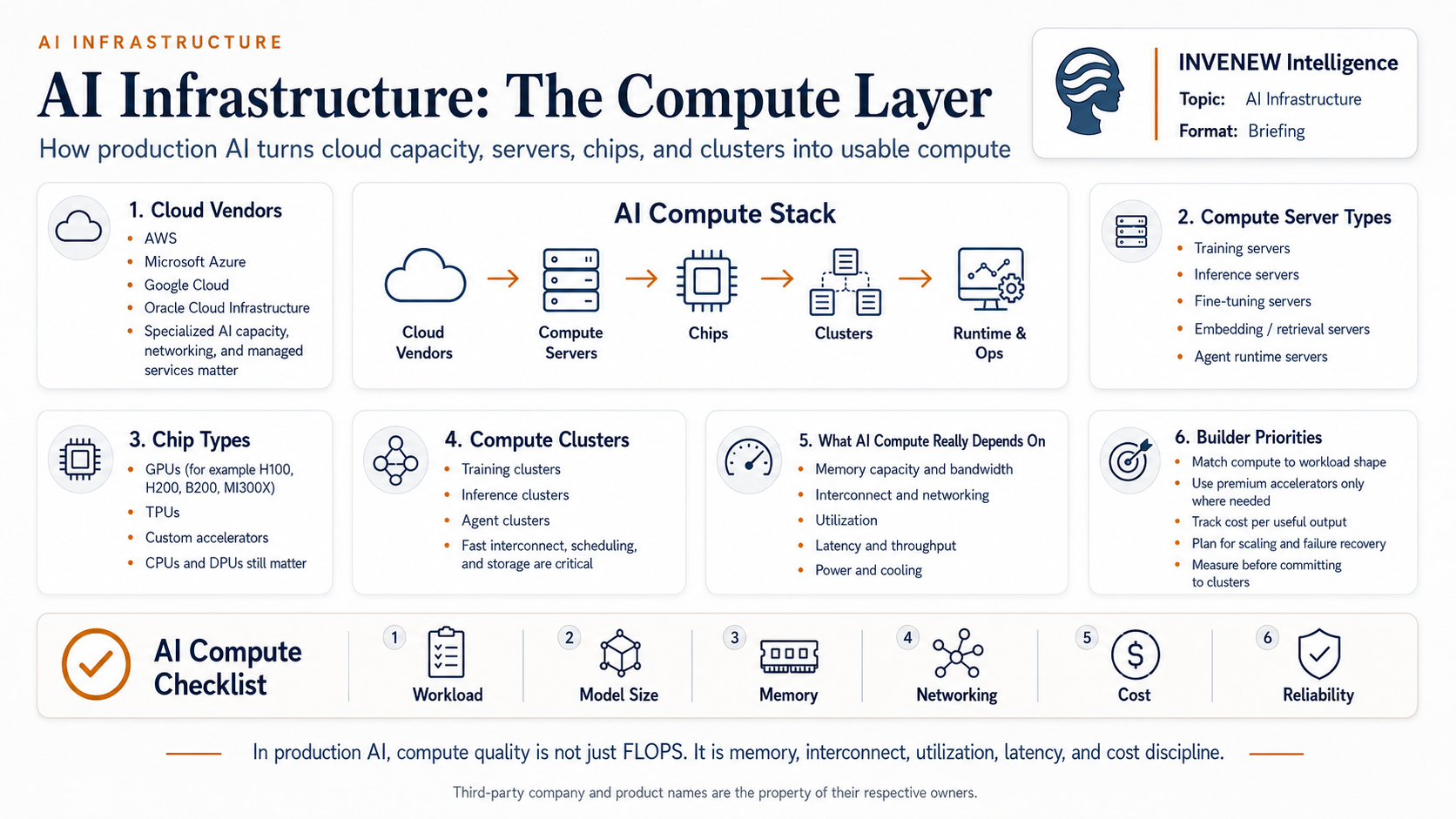
The AI compute stack
A practical AI compute stack has five major layers:
Cloud vendors → Compute servers → Chips → Clusters → Runtime and operations
Each layer changes the economics and reliability of an AI system.
1. Cloud vendors
Cloud vendors provide the infrastructure envelope.
They offer access to GPUs, custom accelerators, storage, networking, managed AI services, security controls, and regional capacity.
The major platforms — AWS, Microsoft Azure, Google Cloud, Oracle Cloud Infrastructure, and others — are now competing on AI infrastructure depth, not just generic cloud services.
For builders, the first compute decision is often not “which chip?” It is:
Which provider gives us the best mix of capacity, cost, networking, managed services, data location, security, and operational control?
That answer will vary by workload.
A startup building an early AI product may begin with hosted APIs and managed inference.
A larger team with predictable volume may move toward dedicated GPU capacity.
A research-heavy team may need clusters.
A regulated company may care more about data location, security, and control.
There is no universal answer. There is only workload fit.
2. Compute server types
AI workloads do not all need the same kind of server.
A training job, a chatbot, a retrieval system, and an agent workflow have different compute profiles.
The useful way to think about servers is by workload.
Training servers are built for heavy model development. They usually need multiple high-end GPUs or accelerators, large memory, fast storage, high-speed interconnect, and strong checkpointing.
They are used for foundation model training, large fine-tuning jobs, multimodal training, synthetic data pipelines, and research workloads.
Inference servers serve models to applications and users. They are optimized for latency, throughput, batching, caching, model loading, routing, concurrency, and cost per token or output.
For many production AI businesses, inference economics matter more than training economics.
A company may train rarely, but infer all day.
Fine-tuning servers sit between training and inference. They are useful when teams adapt models for a domain, customer, workflow, or internal knowledge base.
They may support full fine-tuning, LoRA, adapters, or other efficient tuning methods.
Embedding and retrieval servers support search, RAG, recommendation, document intelligence, and memory systems.
These workloads may use GPUs, CPUs, or specialized inference paths depending on scale.
Agent runtime servers are becoming more important.
An agent is not simply one prompt and one response. It may retrieve context, call tools, generate a plan, execute steps, validate output, retry, ask another model to evaluate, request approval, and write logs.
That means one user request may trigger many model calls and many supporting operations.
For agents, latency and cost compound across the workflow.
This is why agent infrastructure needs more than model serving. It needs runtime discipline.
Chip types in AI compute
The chip layer gets most of the attention, but chip choice only makes sense after the workload is understood.
GPUs
GPUs remain the dominant accelerator for AI workloads.
They are widely used for training, fine-tuning, inference, embeddings, simulation, and high-performance computing.
The GPU advantage is not only hardware. It is also the software ecosystem around the hardware.
Drivers, libraries, frameworks, optimization tools, deployment platforms, and developer familiarity all matter.
That ecosystem is one reason GPUs remain central to AI infrastructure.
But the right GPU depends on the job.
A workload that needs large memory may need a different accelerator profile than a workload that is mostly compute-bound. A workload with strict latency needs a different serving design than a batch job. A workload with predictable volume may justify reserved capacity. A spiky workload may not.
TPUs and custom accelerators
TPUs and other custom AI accelerators are becoming more important as cloud providers try to improve cost, supply control, and power efficiency.
These chips can be compelling when the workload fits the platform well and the software ecosystem is mature enough.
But custom accelerators should be tested carefully.
The right question is not whether the chip is impressive on paper. The right question is:
Does this accelerator make our actual workload faster, cheaper, more reliable, and easier to operate?
CPUs
CPUs still matter.
They are easy to overlook because GPUs get the attention. But production AI systems still depend heavily on CPUs.
CPUs handle application logic, API services, routing, authentication, retrieval orchestration, background jobs, monitoring, tool execution, and workflow coordination.
A production AI system is rarely “just a GPU workload.”
It is a distributed application with AI inside it.
The CPU layer is often the control plane around expensive accelerators.
Networking chips and interconnect
AI clusters are communication-heavy.
The networking layer determines how well servers, accelerators, and storage move data.
High-speed Ethernet, InfiniBand, NVLink-style interconnects, smart NICs, DPUs, and emerging optical networking approaches all matter because idle accelerators are wasted capital.
For large-scale AI, the question becomes:
Can the system keep the accelerators fed with data and synchronized with each other?
If not, raw chip performance does not translate into useful system performance.
Compute clusters: where AI becomes systems engineering
A compute cluster is a group of servers connected to work together.
Clusters matter because many AI workloads are too large or too demanding for one machine.
There are three useful cluster categories.
Training clusters
Training clusters are built for large model training and heavy fine-tuning.
They require many accelerators, fast interconnect, distributed training frameworks, high-throughput storage, checkpointing, job scheduling, fault tolerance, and monitoring.
The hidden challenge is failure.
When a job runs across many machines, something will eventually fail. A node goes down. A network path degrades. Storage slows. A checkpoint fails. A job stalls.
Training clusters need operational maturity, not just hardware scale.
Inference clusters
Inference clusters are built to serve AI models at scale.
They require load balancing, autoscaling, request routing, model replicas, KV cache management, batching, latency monitoring, failover, and cost tracking.
Inference clusters are where AI becomes a product economics problem.
Every token, image, embedding, classification, or agent task has a cost.
Poor routing, weak batching, oversized models, bad caching, and low utilization can make an AI product economically fragile.
Agent clusters
Agent clusters support workflows that combine model calls, tool calls, retrieval, memory, evaluations, guardrails, human approval, logs, traces, retries, and policy checks.
Agents make compute planning harder because they introduce variable execution paths.
A simple request may take one model call.
A complex request may take twenty.
A failed tool call may trigger retries.
A safety check may trigger another model call.
A human approval step may pause the workflow.
That makes agent compute less predictable than traditional request-response inference.
For this reason, agent infrastructure needs strong cost limits, observability, and workflow design.
What AI compute really depends on
The compute conversation often starts with chip names, but the real bottlenecks are more practical.
Memory capacity matters because large models and long-context workflows need room to operate. Long-context inference also increases memory pressure because the system must maintain context during generation.
Memory bandwidth matters because many AI workloads are limited by how fast data moves through memory, not only by raw compute.
Interconnect matters because accelerators need to communicate across servers and nodes. At cluster scale, communication can become the bottleneck.
Storage throughput matters because training, fine-tuning, retrieval, and embedding workflows depend on moving data quickly.
Utilization matters because idle accelerators are expensive. Low utilization often comes from weak scheduling, oversized models, poor batching, slow data pipelines, fragmented capacity, or bad workload placement.
Latency matters because users feel it directly. For agents, latency compounds across model calls and tool calls.
Throughput matters because production AI needs useful outputs over time: tokens generated, documents processed, tickets resolved, code reviewed, searches answered, or agent tasks completed.
Power and cooling matter because AI compute is increasingly a data center constraint. Even when teams use cloud providers, power and cooling influence capacity availability, pricing, and regional expansion.
The best compute system is not always the fastest system.
It is the system that produces the most useful output at the best acceptable cost, latency, and reliability.
A practical architecture for builders
Most builders should not start by trying to operate clusters.
They should start with workload shape.
A practical architecture is tiered.
Tier 1: API-first compute
Use hosted model APIs when you need speed, flexibility, and low operational burden.
Best for prototypes, internal tools, early products, variable demand, and small teams.
The tradeoff is less control over cost, latency, model behavior, and infrastructure.
Tier 2: Managed inference
Use managed endpoints, serverless GPUs, or hosted inference platforms when you need more control but still want operational simplicity.
Best for production apps with moderate scale, RAG systems, internal copilots, and predictable inference workloads.
This is often the practical middle ground.
Tier 3: Dedicated compute
Use dedicated GPU or accelerator capacity when usage becomes predictable and cost optimization matters.
Best for high-volume inference, regular fine-tuning, sensitive workloads, and performance-sensitive applications.
Dedicated capacity can reduce unit costs, but it introduces utilization risk.
Tier 4: Clusters
Use clusters only when the workload justifies the complexity.
Best for large-scale training, high-volume inference platforms, AI infrastructure companies, research labs, and large agent platforms.
Clusters are powerful, but they are not casual infrastructure.
They require scheduling, monitoring, failure handling, security, data engineering, and cost governance.
Tier 5: Hybrid compute
Most mature teams will eventually use hybrid compute.
That may include hosted frontier models for complex reasoning, smaller models for routing, dedicated inference for predictable tasks, batch compute for offline processing, embedding models for retrieval, CPU services for orchestration, and human review for high-risk actions.
This is often the most practical architecture.
Not every task needs the biggest model.
Not every model needs the most expensive chip.
Not every workflow needs real-time execution.
The builder checklist
Before choosing AI compute, answer these questions:
What is the workload: training, fine-tuning, inference, embeddings, retrieval, agents, or batch processing?
What model size is required?
What context length is required?
What latency is acceptable?
What concurrency is expected?
What is the target cost per request, token, task, or workflow?
Is the workload steady or spiky?
Can the workload be batched?
Can smaller models handle part of the workflow?
Does the system need premium accelerators, or only some parts of it?
What memory capacity and bandwidth are needed?
What network performance is required?
What happens when capacity is unavailable?
What needs to be logged, measured, and evaluated?
What cost limit should stop or downgrade the workflow?
The biggest mistake is choosing compute before understanding the workload.
The practical takeaway
AI compute is becoming one of the defining constraints of production AI.
The winners will not simply use more GPUs.
They will know which workloads need premium accelerators, which can use smaller models, which can run asynchronously, which can be cached, which can be batched, and which should stay on managed services until scale justifies more control.
For builders, the compute question is no longer:
What is the best chip?
The better question is:
What is the most reliable and cost-effective compute path for this specific workload?
That is the discipline production AI now requires.
Models create capability.
Compute turns capability into a working system.
And as AI moves from demos to production, compute quality will become one of the clearest differences between systems that scale and systems that stall.
INVENEW exists to help tech builders, operators, founders, and leaders turn AI from experiments into working systems.