In partnership with


The signal
Coding agents are no longer a single product category.
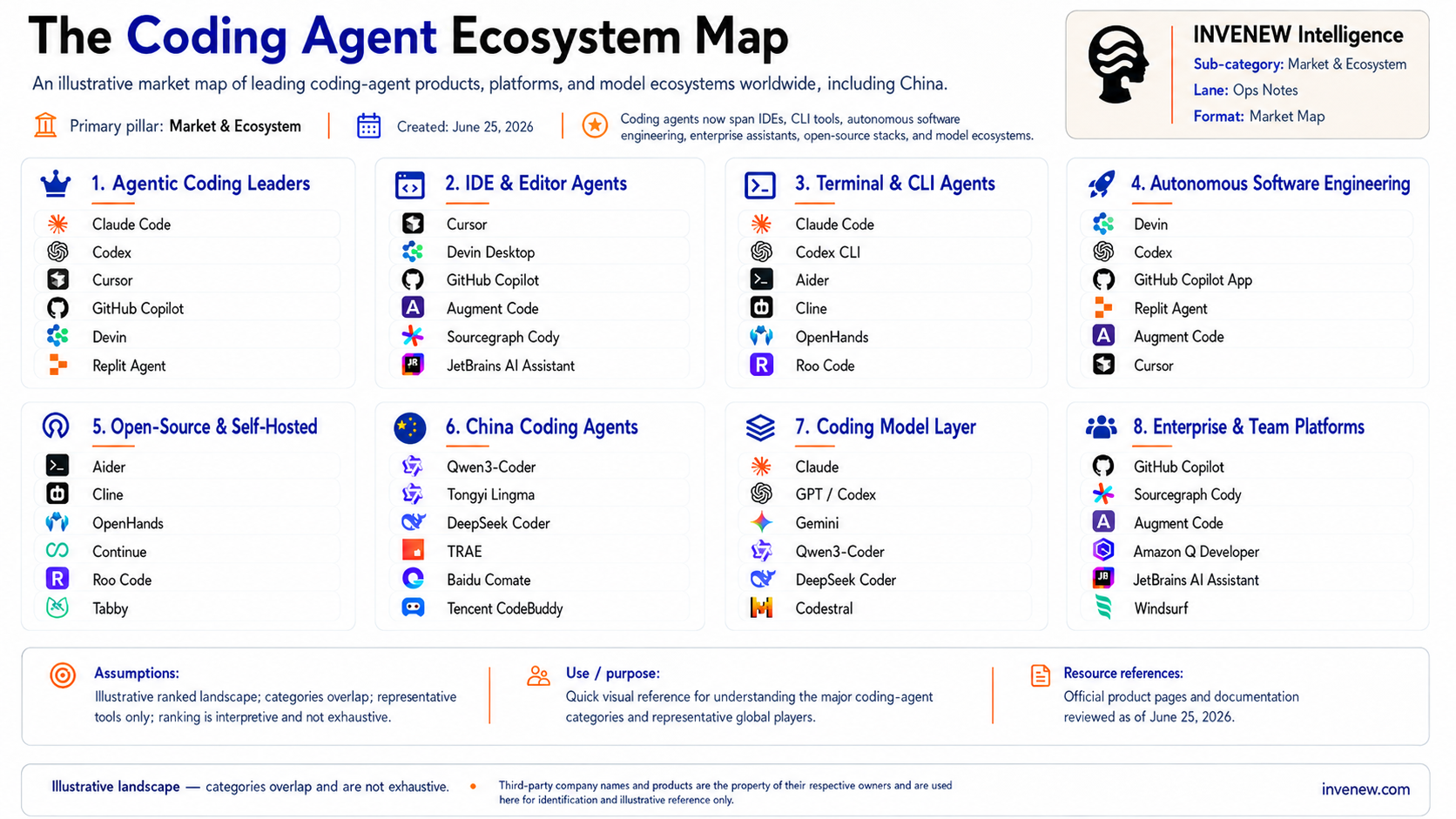
A year ago, many people still treated AI coding tools as autocomplete with a better chat window. That view is now too narrow. The category has expanded into a full ecosystem: IDE agents, terminal agents, autonomous software engineering agents, open-source/self-hosted tools, enterprise coding assistants, model-specific coding systems, and region-specific ecosystems such as China’s fast-moving coding-agent market.
That shift matters because software work is being split across more layers.
Some tools help inside the editor. Some operate from the command line. Some review, refactor, test, or debug. Some attempt larger task execution. Some are tied closely to model providers. Others are becoming platform features inside developer environments, cloud workflows, or enterprise engineering systems.
The practical point: “coding agent” is becoming a stack decision, not just a tool decision.
Why it matters
For tech builders, coding agents change how software gets planned, built, reviewed, and maintained.
A founder or small team may use one agent to scaffold an app, another to review architecture, another to debug deployment issues, and another to write tests or documentation. A larger technical team may care more about permissions, repo context, auditability, security, coding standards, enterprise controls, and how the agent fits into existing developer workflows.
That means the buying or adoption question cannot be reduced to popularity.
The better question is:
Where in the software workflow does this agent create reliable leverage?
For some teams, the best answer may be an IDE-native tool. For others, it may be a terminal-first workflow. For teams handling sensitive codebases, self-hosted or more controllable options may matter. For product and engineering leaders, the real issue is whether the tool improves delivery quality without creating hidden review, security, or maintenance debt.
The builder/operator view
The emerging coding-agent ecosystem can be read as several layers.
IDE and editor agents sit close to the developer’s daily workflow. They are useful when the work needs tight interaction with files, code context, refactoring, and incremental changes.
Terminal and CLI agents are better suited for command-driven workflows: repo inspection, codebase edits, scripted tasks, debugging loops, and developer workflows that already live close to Git, shell, and local tooling.
Autonomous software engineering agents aim higher: issue-to-pull-request workflows, longer task execution, multi-step debugging, or more independent software work. These are promising, but they also require stronger review gates.
Open-source and self-hosted tools matter because not every team wants a closed product between its codebase and an external model. Control, privacy, extensibility, and local workflow fit become part of the decision.
Enterprise and team platforms are where governance enters the picture: permissions, policy, usage visibility, audit trails, security posture, and integration with the existing engineering system.
The model layer matters because coding quality is partly shaped by the underlying model: reasoning ability, context handling, tool use, latency, cost, code understanding, and ecosystem integration.
That is why the category map is useful. It prevents builders from comparing everything as if it belongs in one bucket.
What to watch
1. The IDE vs. CLI split
Some builders will stay inside editor-native agents. Others will move toward terminal-first workflows because they want more control, repeatability, and automation around repositories, scripts, tests, and deployment steps.
2. The rise of agent review loops
The strongest workflows may not be “one agent builds everything.” They may be builder agent → reviewer agent → test/debug agent → human approval. That makes review architecture more important than raw code generation.
3. Enterprise pressure around control
As coding agents touch real codebases, teams will care more about access, data exposure, policy, audit logs, and whether the agent can be trusted inside regulated or business-critical environments.
4. Open-source as a serious lane
Open-source and self-hosted coding agents may become important for teams that want local control, customization, or the ability to inspect and adapt the workflow.
5. Global ecosystem divergence
The coding-agent market is not only a U.S. platform story. Chinese model and developer-tool ecosystems are developing their own coding-agent layers, which may influence pricing, capability, open-source competition, and regional adoption patterns.
Practical takeaway
Do not choose a coding agent by asking, “Which one is the best?”
Start with the workflow:
What part of software work do you want to improve — ideation, scaffolding, code editing, refactoring, tests, debugging, reviews, documentation, deployment support, or issue execution?
Then map the tool to that workflow.
A simple decision frame:
Editor work → IDE agent
Repo/task automation → CLI agent
Issue-to-PR experiments → autonomous agent
Privacy/control needs → open-source or self-hosted option
Team governance needs → enterprise platform
Model-sensitive coding tasks → evaluate the model layer
The category is moving quickly, but the discipline stays the same: define the job before choosing the tool.
INVENEW Lens
For INVENEW Intelligence, the coding-agent ecosystem is not just a market map. It is a signal about how AI-native software work is being reorganized.
The next useful layer is not another list of tools. It is a practical evaluation system: where each coding agent fits, what workflow it improves, what risks it introduces, and what review gates are needed before using it in real software work.
For INVENEW Labs, this is a strong candidate for a recurring Tool Test or Benchmark series: compare coding agents by workflow fit, review quality, repo understanding, debugging usefulness, deployment awareness, cost, and human approval needs.
That is how the ecosystem map becomes useful: not as a ranking, but as a decision map for builders turning AI into working software systems.
INVENEW exists to help tech builders, operators, founders, and leaders turn AI from experiments into working systems.
In partnership with
Stop letting busywork get in the way of selling

Researching accounts. Building lists. Writing sequences.
There's a better use of your team's time.
Apollo is the AI revenue engine that handles the busywork, so you can stay focused on selling.
Plus, everything you need is in one place:
230M+ verified contacts
AI-powered outreach
Data enrichment
Inbound lead capture
Meeting scheduler
And more
Stop doing busywork and start building pipeline, faster.
With Apollo — the AI revenue engine powering 4M+ users.