

In This Issue
The major layers behind modern AI systems
Why the infrastructure bottleneck keeps moving
Three corrections needed in the accompanying infographic
What builders, operators, and leaders should monitor
The signal
AI feels like software because most people encounter it through a chat window, API, coding assistant, or application. Underneath that interface is an industrial system that begins with semiconductor manufacturing and ends inside a business workflow.
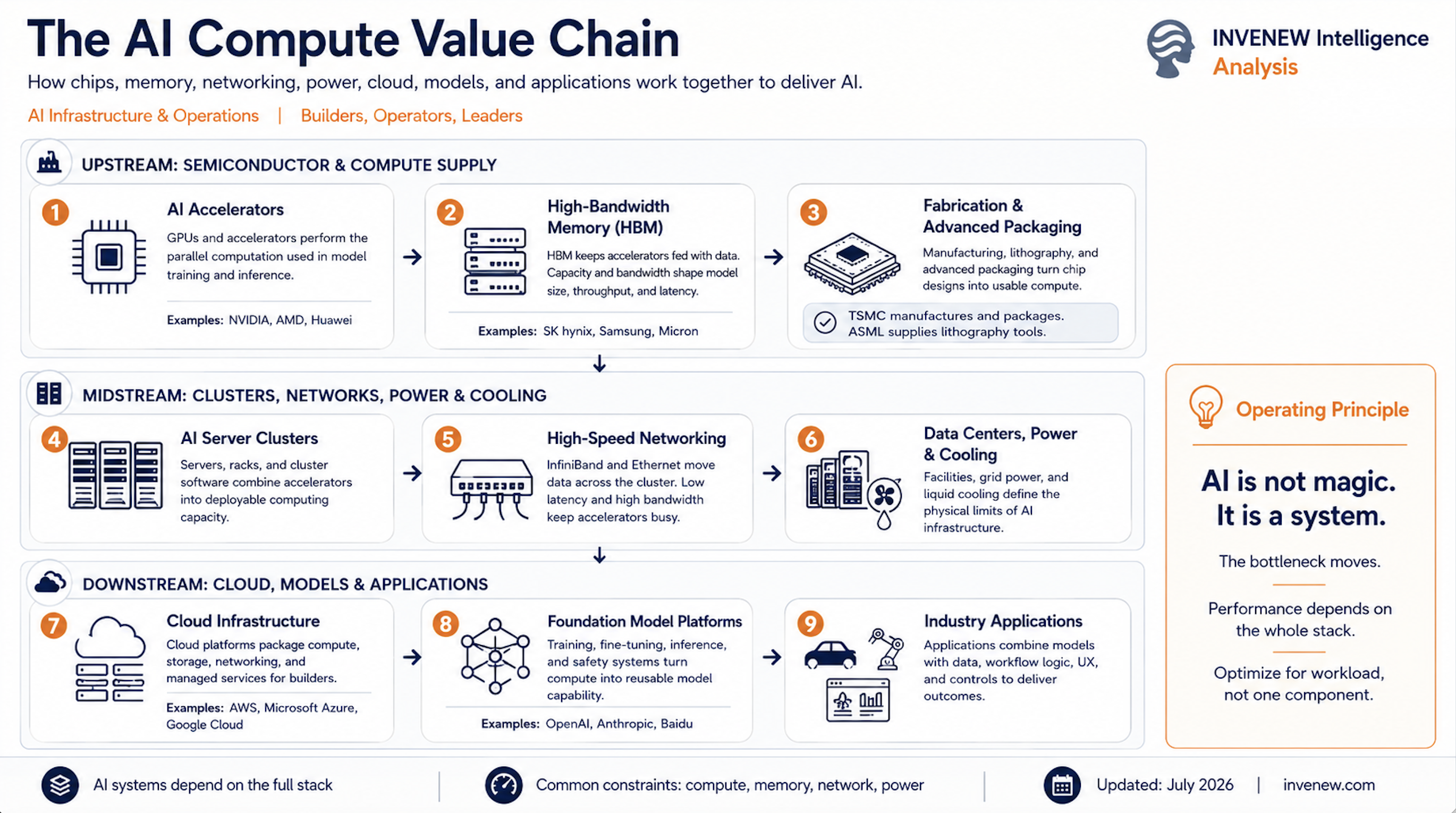
The accompanying infographic captures the broad shape of this system. It moves from accelerators, high-bandwidth memory, and advanced packaging to clusters, networking, data centers, cloud platforms, foundation models, and industry applications.
Its central idea is correct. Every useful AI response depends on several technical and operational layers working together.
Upstream: creating usable compute
The first layer is accelerated computing. GPUs and other AI accelerators perform the parallel mathematical operations used in model training and inference. Their published peak performance provides one measure of capability, while the surrounding memory, networking, packaging, power, and software determine how much of that capability becomes usable.
Memory is the next major component. High-bandwidth memory, or HBM, sits close to the accelerator so large volumes of data can move quickly between memory and compute. NVIDIA’s H200, for example, combines 141 GB of HBM3e with 4.8 TB/s of memory bandwidth. This illustrates why memory capacity and bandwidth matter for large models, long contexts, and demanding inference workloads.
Advanced packaging connects compute dies, HBM stacks, interposers, and other components into a working package. TSMC describes CoWoS as an advanced 2.5D packaging technology that integrates multiple systems-on-chip and HBM stacks for high-performance computing and AI products.
The infographic requires a correction here. ASML supplies lithography systems used to print complex chip patterns onto silicon wafers. That places ASML within semiconductor manufacturing equipment rather than advanced packaging. The graphic also duplicates TSMC and misspells one instance as “TSSMC.”
Midstream: turning hardware into capacity
An accelerator becomes useful at scale when it is integrated into servers, racks, and clusters. Those systems also require CPUs, storage, firmware, drivers, schedulers, orchestration, and management software.
Networking determines how efficiently thousands of accelerators can work together. Distributed training and large-scale inference require processors to exchange data continuously. AI networks therefore need high bandwidth and very low latency to reduce the time accelerators spend waiting for data.
This explains why adding more GPUs may produce diminishing returns. A cluster can become constrained by memory pressure, network congestion, storage throughput, scheduling delays, or inefficient software.
Power and cooling create the physical boundary. Increasing AI and high-performance computing density is accelerating the adoption of direct-to-chip liquid cooling and coolant distribution units. These systems transfer heat away from processors and help facilities support increasingly dense racks.
The power requirement extends beyond the data hall. The International Energy Agency estimates that data centers consumed approximately 415 TWh of electricity in 2024. Its base case projects that consumption will more than double to about 945 TWh by 2030, with accelerated servers accounting for a large share of the increase.
Compute capacity increasingly depends on access to electricity, grid connections, transformers, land, cooling systems, and construction capacity.
Downstream: turning capacity into outcomes
Cloud platforms package compute, networking, storage, and operating software into services that builders can consume without constructing their own data centers.
AWS provides AI infrastructure across NVIDIA GPUs, its Trainium accelerators, networking, storage, and managed services. Microsoft Azure combines GPU-powered virtual machines with accelerated networking, storage, cluster management, and optimization frameworks. Google describes AI Hypercomputer as an integrated system of optimized hardware, open software, machine-learning frameworks, and flexible consumption models.
The infographic combines “Cloud Services & MaaS” into one box. These are related but distinct layers.
Cloud infrastructure supplies compute, storage, networking, orchestration, and managed operating environments. Model-as-a-service supplies access to trained models through APIs or managed endpoints. A builder may consume both services, but they serve different purposes in the value chain.
Foundation-model developers convert large amounts of compute, data, and engineering work into reusable capabilities such as language generation, reasoning, vision, audio, and coding.
Applications then combine those capabilities with domain data, workflow logic, user experience, security, permissions, and business rules. This is where technical capability becomes economic value. The model generates an output. The application makes that output useful within a specific task.
The bottleneck keeps moving
The most useful lesson from the value chain is that the constraint rarely remains in one place.
More accelerator supply can expose shortages in memory or packaging. More servers can expose network and storage limits. Denser racks can expose cooling, transformer, or grid constraints. Greater model capacity can expose weak data pipelines, poor evaluations, high inference costs, or limited business demand.
Infrastructure decisions should therefore begin with the workload:
What latency, throughput, and reliability does it require?
Where does the system currently spend time waiting?
What does each successful task cost?
Which dependencies create concentration or operational risk?
Which components must scale together?
The performance of the complete system matters more than the specification of any single component.
What this means for builders, operators, and leaders
Builders should begin with workload requirements. Model size, traffic, context length, data sensitivity, latency, and budget should shape the architecture. Many useful products depend more on efficient inference and strong workflow integration than on frontier-scale training infrastructure.
Operators should measure the complete path. Accelerator utilization matters alongside queue time, memory pressure, network congestion, storage throughput, retries, energy use, failure rates, and cost per successful task.
Leaders should treat AI infrastructure as both a technology decision and a dependency decision. Choices involving chips, clouds, models, and platforms affect capacity, pricing, portability, data location, software compatibility, resilience, and bargaining power.
The strongest architecture balances its components around the outcome the organization needs.
Takeaways
AI depends on a complete industrial and technical value chain.
Compute performance is shaped by memory, packaging, networking, power, cooling, and software.
Cloud infrastructure and model services occupy different parts of the system.
New capacity at one layer often reveals a constraint somewhere else.
Architecture should be optimized around workload requirements and cost per useful outcome.
The International Energy Agency’s Energy and AI report explains how accelerated computing, data-center growth, electricity supply, and grid constraints are becoming part of AI infrastructure planning.
Which part of the AI compute value chain is creating the greatest constraint in your work today?
The Most Intuitive AI agent for Executives

Catch is an AI admin that's as easy as a conversation. Just call Catch and talk, like you would any assistant. Scheduling, bookings, follow-ups: say it once, consider it done. No apps to learn, no forms to fill. Get started at catchagent.ai and speak to your admin savior today.
Note: Third-party company and product names belong to their respective owners and are used for identification and illustrative reference only.
INVENEW exists to help tech builders, operators, founders, and leaders turn AI from experiments into working systems.