

In This Issue
Why deploying an AI application involves more than shipping application code.
The path from source control through testing, staging, release, and production.
The additional artifacts and evaluation gates AI applications require.
How progressive delivery, observability, and rollback reduce deployment risk.
What builders and operators should do before exposing a new version to users.
Building an AI application and operating one in production are different disciplines.
A prototype may work with a local interface, a model API, a few prompts, and a small document collection. Production introduces real users, changing traffic, sensitive data, external dependencies, service limits, security requirements, and consequences when outputs are wrong.
The deployment path is the controlled process that moves an application from a developer’s environment into production.
For a conventional application, that path usually covers code, dependencies, configuration, infrastructure, and data migrations. An AI application may also depend on model versions, prompts, retrieval pipelines, vector indexes, tools, guardrails, evaluation datasets, and model-provider settings.
These components must move through the deployment system as a traceable release rather than as a collection of unrelated changes.
Deployment and release are not the same
A deployment places a new version of software or configuration into an environment.
A release makes that version available to users.
The two actions can occur at different times.
A team may deploy a new application version while keeping it hidden behind a feature flag. It can then test the version in production, expose it to internal users, send it a small percentage of traffic, and expand access only after the evidence supports doing so.
Separating deployment from release gives teams more control. It also makes rollback less disruptive because user access can sometimes be disabled without rebuilding or redeploying the application.
The deployment path
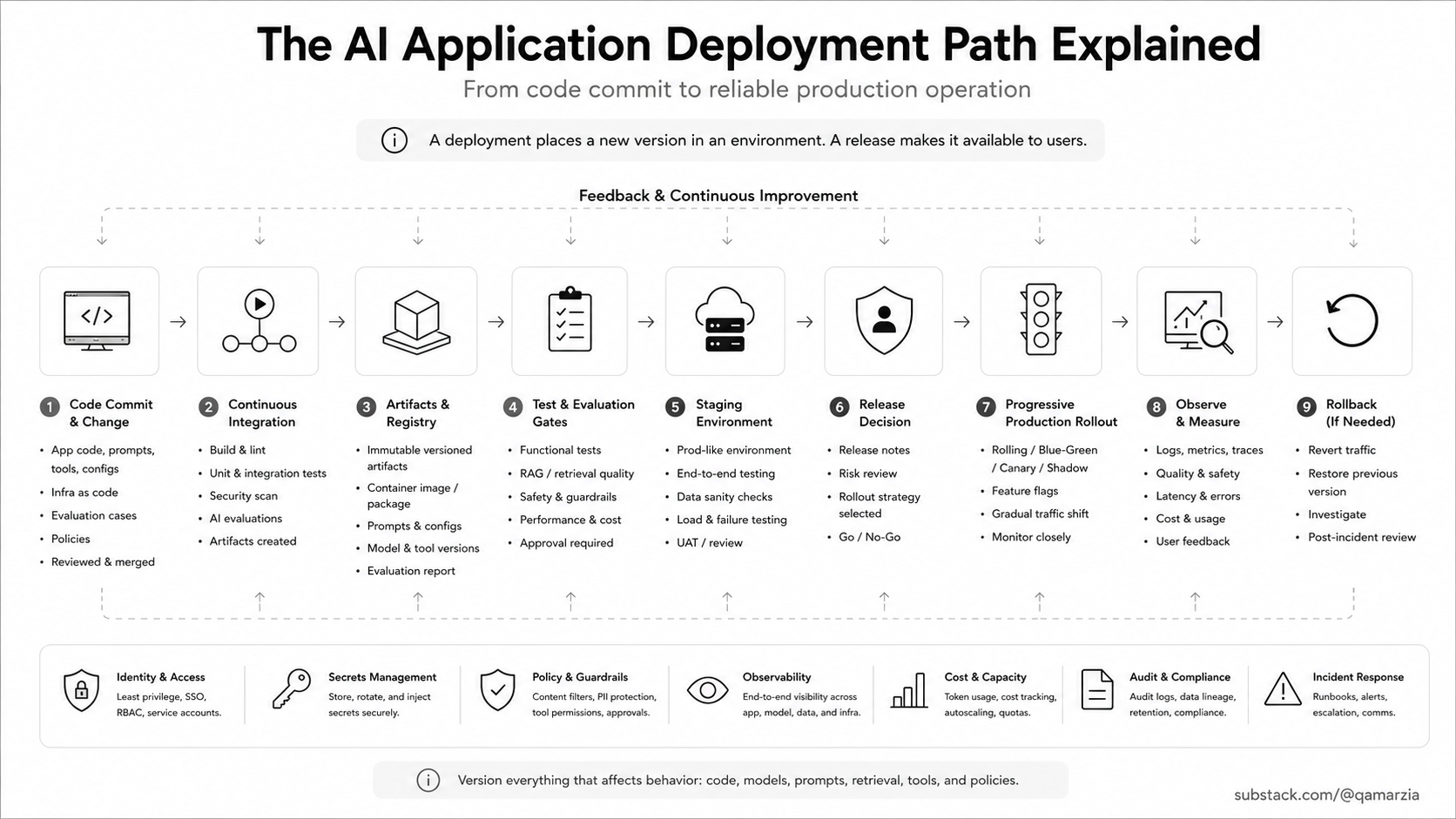
A practical AI application deployment path looks like this:
Source control → Continuous integration → Artifact registries → Test and evaluation → Staging → Release decision → Progressive production rollout → Observation → Expansion or rollback
The path is not simply a sequence of tools. Each stage answers a different operational question.
1. Source control establishes the release record
The deployment path begins when a change is committed to source control.
That change may include:
Application code
Infrastructure definitions
Prompt templates
Agent instructions
Tool definitions
Retrieval configuration
Evaluation cases
Security policies
Model and provider settings
A release should be tied to a specific, reviewable version of these components. Recording only the application code is not enough when a prompt, retrieval rule, or model identifier can materially change system behavior.
Sensitive values such as API keys, passwords, and certificates should not be stored in the source repository. They should be supplied through an approved secrets-management process at deployment or runtime.
2. Continuous integration verifies the change
A continuous integration pipeline starts when the repository receives an approved change.
The pipeline commonly performs:
Dependency installation
Static analysis
Unit tests
Integration tests
Security scanning
Container or package creation
Infrastructure validation
AI evaluation checks
Traditional tests verify whether software behaves according to deterministic expectations.
AI evaluations answer a different question: does the system continue to produce acceptable results for the intended use case?
An evaluation suite might test answer quality, retrieval relevance, policy compliance, tool selection, structured-output validity, latency, and cost. Because generative outputs can vary, these tests often use thresholds, scoring rules, reference cases, or human review rather than exact text matching.
Google’s MLOps guidance treats testing and automated validation as core parts of continuous delivery for machine-learning systems. AWS similarly recommends monitoring output quality, maintaining traceability, versioning artifacts, and automating lifecycle management for generative AI applications.
Passing the pipeline does not prove that a release is safe. It shows that the release has met the team’s defined minimum conditions for moving forward.
3. Registries hold immutable release artifacts
The pipeline should produce versioned artifacts rather than rebuild the application independently in every environment.
Artifacts may include:
A container image or application package
Infrastructure templates
Prompt and policy bundles
Evaluation reports
Dependency manifests
Model-serving configuration
The same tested artifact should move from staging into production. Rebuilding it later can introduce dependency changes or other differences that were never evaluated.
The environment may supply different endpoints, credentials, capacity settings, or access policies, but the application artifact itself should remain identifiable and reproducible.
AI applications have several versioned dependencies
An AI application is not one deployable object.
Its behavior may depend on a combination of:
Application version
The interface, workflow logic, APIs, and business rules.Model version
The hosted model identifier, model weights, fine-tuned adapter, or inference configuration.Prompt version
System instructions, templates, examples, and output requirements.Retrieval version
Chunking logic, embedding model, search configuration, reranking, document corpus, and index state.Tool version
The APIs, functions, permissions, and schemas available to an agent.Policy version
Guardrails, access rules, approval thresholds, and escalation conditions.
A reliable release record should identify the important versions that operated together. Without that record, a team may know that an incident occurred after a deployment but remain unable to reconstruct which combination produced it.
Staging verifies the assembled system
Staging provides a production-like environment where the complete release can be exercised before broad exposure.
The objective is not to reproduce every aspect of production perfectly. It is to catch failures that cannot be detected when components are tested separately.
These may include:
Incorrect environment configuration
Missing permissions
Unreachable model or retrieval endpoints
Broken tool integrations
Data-schema incompatibility
Token or context-limit failures
Unexpected latency
Unsafe action paths
Logging or tracing gaps
Capacity and rate-limit problems
Staging should use representative data and traffic patterns without unnecessarily copying sensitive production information.
For high-impact workflows, technical validation may be followed by product, security, compliance, or business approval. The level of review should reflect the authority given to the application and the consequences of failure.
Production rollout should control exposure
A successful staging test does not guarantee successful production behavior. Real traffic is more varied, dependencies behave differently under load, and users provide inputs the development team did not anticipate.
The production release should therefore limit initial exposure when the risk justifies it.
Common rollout patterns include:
Rolling deployment
Instances running the old version are gradually replaced by instances running the new one.
Kubernetes Deployments support rolling updates by incrementally replacing workloads while maintaining availability. Kubernetes can also preserve deployment history and return a workload to a previous revision.
Rolling deployments are operationally straightforward, but old and new versions may run simultaneously. Compatibility across application versions, APIs, and data schemas must therefore be considered.
Blue-green deployment
The current version and the new version run in separate environments. Traffic moves to the new environment after validation.
This provides a clear fallback, but temporarily maintaining both environments can increase infrastructure cost and operational complexity.
Canary release
A small portion of traffic is sent to the new version. Exposure increases only when predefined health, quality, and business conditions remain acceptable.
Canary releases are useful when production evidence is needed before full rollout. They require reliable traffic control, version-level telemetry, and an explicit decision process.
Shadow testing
Production requests are copied to the new system without using its responses in the live user experience.
This can reveal performance and behavioral differences under realistic traffic. Sensitive-data controls and additional inference costs still apply.
No rollout strategy removes risk. The purpose is to limit the number of users, transactions, or workflows affected while the team gathers evidence.
Observability must cover the whole AI system
Infrastructure monitoring alone cannot show whether an AI application is working properly.
Teams may need to observe:
Availability and error rates
End-to-end latency
Model latency and token usage
Cost by request, user, workflow, or model
Retrieval quality
Tool calls and failures
Guardrail interventions
Output-format compliance
User feedback
Evaluation scores
Changes in request patterns
Model-provider quotas and rate limits
AWS recommends observability across the full generative AI system, from foundation models through user interactions, rather than monitoring individual infrastructure components in isolation.
Every production event should be traceable to the deployed application, model, prompt, retrieval, tool, and policy versions where practical.
Without version-aware telemetry, teams can see that performance changed but struggle to determine why.
Rollback must be designed before release
A rollback is not merely a command issued after a failure.
The team must decide in advance:
Which conditions stop the rollout
Who has the authority to stop it
Whether traffic can return to the previous version
Whether prompts or configuration can be reverted separately
Whether data or index changes are backward compatible
How in-progress workflows will be handled
How users and internal stakeholders will be informed
Application rollback may be quick. Database migrations, retrieval-index changes, and externally triggered agent actions may not be reversible.
That is why safer deployment favors backward-compatible changes, limited authority, staged exposure, idempotent operations, and human approval for consequential actions.
Reference architecture
A practical deployment control path is:
Developer → Source Repository → CI Pipeline → Test and Evaluation Gates → Artifact Registries → Staging Environment → Release Control → Production Runtime
The production runtime may include:
Application → AI Gateway → Model or Inference Service → Retrieval and Data Services → Tools and External Systems
The following capabilities operate across the full path:
Identity and Access → Secrets Management → Policy Enforcement → Observability → Audit Records → Incident Response → Rollback
The model is one part of the deployed system. Production reliability depends on the complete path.

Builder takeaway
Treat prompts, model choices, retrieval settings, tools, policies, and evaluations as versioned parts of the product.
Build the evaluation suite alongside the application rather than after development ends. Design changes so they can be released gradually and reverted independently. A prototype becomes deployable when its behavior can be tested, traced, controlled, and reproduced.
Operator takeaway
Operate the release, not only the infrastructure.
Track which versions are serving traffic, which users are exposed, whether quality remains acceptable, and whether costs or latency are changing. Establish rollout thresholds, stop conditions, rollback ownership, and escalation paths before production traffic reaches the new version.
General takeaways
Version the full AI system, not only its application code.
Use automated software tests and AI-specific evaluations as release gates.
Promote the same tested artifact through staging and production.
Separate deployment from user release where possible.
Start production exposure narrowly when uncertainty or impact is high.
Observe output quality, cost, latency, tools, retrieval, and infrastructure together.
Define rollback criteria and ownership before beginning the rollout.
Where does your current deployment path become least reliable: evaluation, release control, observability, or rollback?
INVENEW exists to help tech builders, operators, founders, and leaders turn AI from experiments into working systems.
In partnership with
Why did one company's AI work, and another's didn't?

One had a dedicated owner. Resolution rate: 48.9%. One didn't: 0.38%. See the full breakdown.
Note: Third-party company and product names belong to their respective owners and are used for identification and illustrative reference only.