In partnership with


The signal
AI application development is becoming a distinct software stack.
The early pattern was relatively simple: choose a model, connect an API, build an interface, and release a prototype.
That still works for experiments. A useful application, however, usually requires considerably more.
It may need coding agents, agent frameworks, model APIs, databases, vector retrieval, memory, workflow orchestration, authentication, background jobs, deployment infrastructure, evaluations, monitoring, and human review.
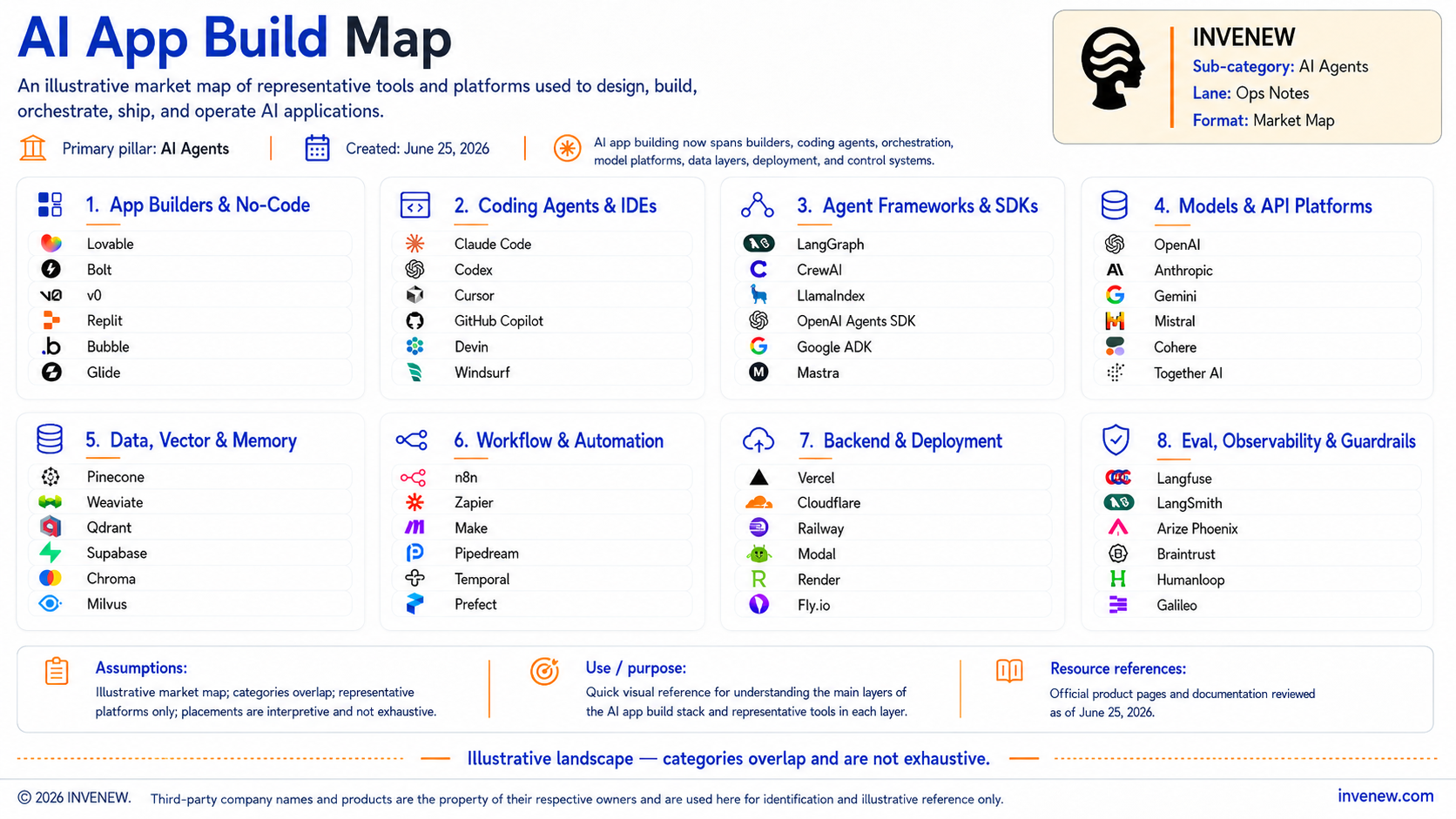
The attached map illustrates eight parts of that emerging ecosystem:
App builders and no-code platforms
Coding agents and IDEs
Agent frameworks and SDKs
Models and API platforms
Data, vector, and memory systems
Workflow and automation tools
Backend and deployment platforms
Evaluation, observability, and guardrail tools
The important shift is not that every application needs every category. It is that builders now need to understand which layers their application genuinely requires.
Why it matters
AI builders are making more architectural decisions earlier in the build process.
Choosing a model is only one of them.
A builder may also need to decide:
whether the application needs agents or a simpler model call
where workflow logic should live
how context and memory will be stored
whether vector retrieval is actually necessary
which actions require human approval
how the system will be deployed
what should be logged and evaluated
how failures, latency, and costs will be managed
These decisions shape reliability, cost, security, maintainability, and the speed at which the application can evolve.
The stack should therefore follow the workflow—not the other way around.
The builder/operator view
App builders and no-code platforms
These tools help turn an idea into an interface, prototype, or working application quickly.
They are useful for validating user journeys, testing product assumptions, and building the first usable version. Their main tradeoff is control: the faster the abstraction, the more carefully builders need to understand what sits underneath it.
Coding agents and IDEs
Coding agents are becoming part of the development workflow rather than a separate assistant window.
They can scaffold features, inspect repositories, refactor code, debug errors, generate tests, explain unfamiliar systems, and support architecture reviews.
The strongest workflows will often combine an agent with clear repository context, coding standards, review gates, testing, and human judgment.
Agent frameworks and SDKs
Frameworks help coordinate tools, memory, prompts, state, handoffs, and multi-step agent behaviour.
They become valuable when an application needs more than a single request-and-response interaction. They also introduce complexity, so builders should confirm that an agent framework solves a real workflow need before adding one.
Models and API platforms
The model layer supplies reasoning, generation, multimodal capabilities, tool use, and structured outputs.
Model choice affects quality, latency, cost, context limits, deployment options, and provider dependency. Many applications will increasingly use more than one model, routing work according to task, price, speed, or reliability.
Data, vector, and memory
AI applications need clear boundaries between operational data, user data, documents, embeddings, conversation state, metadata, logs, and long-term memory.
A vector database is not automatically required. Builders should first decide what information must be retrieved, how fresh it must be, how access is controlled, and whether ordinary search or relational queries would be simpler.
Workflow and automation
Workflow systems connect triggers, applications, APIs, tasks, schedules, and approval steps.
This layer is where many AI experiments become repeatable business processes. It also determines where human review, retries, escalation, and error handling belong.
Backend and deployment
The backend handles application logic, authentication, storage, queues, APIs, jobs, integrations, and deployment.
Even when an app builder hides much of this infrastructure, the system still needs clear ownership of data, permissions, execution, and operational behaviour.
Evaluation, observability, and guardrails
This layer helps teams understand whether the application is working as intended.
That includes output quality, traces, latency, token use, cost, tool calls, failures, user feedback, safety rules, and approval decisions.
Evaluation should not be treated as a final testing step. It should become a continuing feedback loop between building, releasing, observing, and improving.
What to watch
1. Platforms will keep absorbing adjacent categories
Coding tools will add deployment. Deployment platforms will add agents. Model providers will add orchestration. App builders will add databases, workflows, and evaluation.
Category boundaries will become less clear even as the underlying architectural responsibilities remain distinct.
2. Model choice will become less permanent
Applications will increasingly route tasks across models rather than depend on one provider for every workload.
This makes model abstraction, evaluation, and fallback design more important.
3. Workflow orchestration will become a key control point
The durable value may sit less in the prompt and more in how the system coordinates inputs, tools, data, approvals, retries, and outputs.
4. Evaluation will move closer to development
Builders will need test cases, expected behaviours, traces, and feedback loops while features are being created—not only after release.
5. Simpler stacks will often win
The map should not become a shopping list.
A small, understandable stack with clear responsibilities will usually be easier to operate than a complicated collection of fashionable tools.
Practical takeaway
Map the application before selecting the stack.
Start with seven questions:
What user outcome should the application produce?
What workflow turns the input into that outcome?
Where is AI genuinely required?
What data and context does the system need?
What actions require approval or restrictions?
How will the application be deployed and observed?
What evidence will show that it is working?
Then choose the smallest set of tools that supports those answers.
INVENEW Lens
The AI App Build Map represents the part of AI development that often gets skipped between idea and implementation: understanding the full system.
INVENEW Intelligence will continue mapping these categories, explaining the architectural tradeoffs, and helping builders distinguish essential system layers from optional complexity.
INVENEW Labs can take the next step by testing representative tools and workflows across the map: app builders, coding agents, orchestration frameworks, deployment platforms, and evaluation systems.
The purpose is not to declare one universal stack.
It is to help builders make better stack decisions for the application they are actually trying to build.
Note: Third-party company and product names belong to their respective owners and are used for identification and illustrative reference only.
INVENEW exists to help tech builders, operators, founders, and leaders turn AI from experiments into working systems.
In partnership with
The best prompt engineers aren't typing. They're talking.

Power users figured this out early: speaking a prompt gives you 10x more context in half the time. You include the edge cases, the examples, the tone you want — because talking is fast enough that you don't skip them.
Wispr Flow captures everything you say and turns it into clean, structured text for any AI tool. Speak messy. Get polished input. Paste into ChatGPT, Claude, Cursor, or wherever you work.
89% of messages sent with zero edits. 4x faster than typing. Works system-wide on Mac, Windows, and iPhone.