
Sponsored
The AI Accuracy Flywheel turns every wrong answer into a test and sends the correction back into the model, so the same mistake doesn’t come back.
In This Issue
Why AI agent marketplaces are becoming an important route to enterprise customers.
How ChatGPT, Salesforce, Microsoft, Google, and ServiceNow are approaching agent distribution.
What marketplaces offer builders, and what control they may require in return.
How to decide between a standalone product, a platform-native agent, and a hybrid approach.
The signal: agents are moving into established workflows
The next generation of AI software is beginning to appear where people already work.
An employee using ChatGPT can connect to business systems and perform supported actions. A Salesforce customer can discover agents inside its existing ecosystem. Microsoft customers can find AI agents alongside other business applications through Microsoft Marketplace.
Google has also brought partner-built agents into Gemini Enterprise, while enterprise software vendors are connecting their workflows to conversational AI platforms.
These developments point to a change in how AI products reach customers.
The early AI agent market largely focused on building agents: selecting models, connecting tools, adding memory, and defining workflows.
Now the distribution layer is becoming more important.
Vendors are creating ways to discover, evaluate, activate, and govern agents inside platforms that customers already use.
For an independent builder, this creates an opportunity to reach customers without building every part of the surrounding application.
It also raises a strategic question.
If the platform provides the interface, identity, distribution, and access to business systems, what does the independent agent developer still own?
What an AI agent marketplace actually is
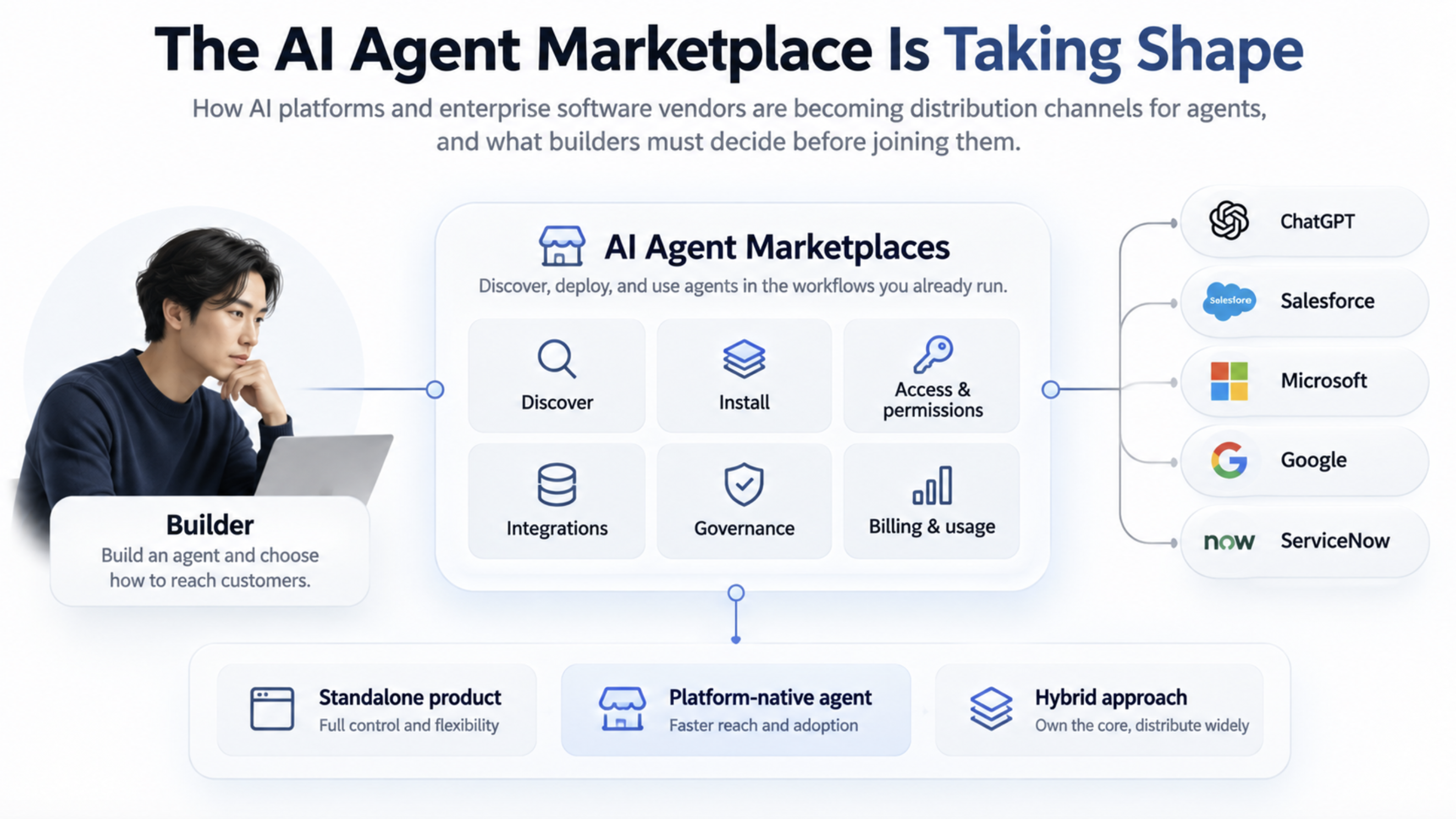
An AI agent marketplace is a platform where organizations or individuals can discover and adopt agents, agent-powered applications, or tools that extend an AI system.
The term covers different products.
Some marketplaces list complete agents designed to carry out a business workflow. Others distribute connectors that let an existing assistant interact with external applications. Some offer reusable components that developers incorporate into agents they build themselves.
These differences matter.
A connector that exposes customer records does not necessarily contain an autonomous agent. A packaged agent may include its own instructions, decisions, tools, and operating workflow. An agent-enabled application may provide a full user interface and business process.
All three can appear in today's agent marketplace ecosystem.
A typical marketplace provides some combination of discovery, installation, authentication, administration, billing, and deployment support.
But listing an agent does not automatically mean the marketplace verifies its business outcomes, guarantees its security, or accepts responsibility for its actions.
Those conditions must be checked separately.
The market map: five distribution approaches
The major platforms are pursuing related but distinct approaches.
Platform | Distribution approach | Practical implication |
|---|---|---|
ChatGPT | App directory and connected tools | Reach users already working through conversational AI |
Salesforce AgentExchange | Agents, apps, and tools within the Salesforce ecosystem | Build around enterprise CRM data and workflows |
Microsoft Marketplace | AI agents and applications alongside cloud and business software | Use established enterprise purchasing and deployment channels |
Google Gemini Enterprise | Partner agents accessible through its Agent Gallery | Reach organizations adopting a centrally managed AI workspace |
ServiceNow | Governed workflow integrations and agent orchestration | Bring agent actions into established enterprise processes |
Each platform starts with an existing advantage.
ChatGPT has a conversational interface. Salesforce has customer and business-process context. Microsoft has enterprise software, cloud infrastructure, and procurement relationships. Google has its enterprise AI environment. ServiceNow has operational workflows and governance controls.
These are different entry points into the same emerging market.
The competition is increasingly about which environment becomes the place where users discover and invoke agents.
It is too early to declare a dominant marketplace model.
What recent developments tell us
Three developments help explain the direction.
First, discovery is moving closer to the user's work.
OpenAI opened submissions to the ChatGPT app directory in December 2025. Developers can build connected experiences using the Apps SDK, which is based on the Model Context Protocol, or MCP.
Instead of requiring someone to open another application, an approved app can become available through ChatGPT.
That reduces one kind of friction: the user does not need to begin every task from a separate software interface.
Second, enterprise marketplaces are incorporating agents into existing buying processes.
Salesforce describes AgentExchange as a unified marketplace combining applications, Slack solutions, and agent-related tools.
Microsoft Marketplace likewise includes an AI Apps and Agents category alongside established cloud and business offerings.
For enterprise customers, this could simplify discovery and procurement. For developers, the trade-off is greater dependence on a platform's publishing, commercial, and integration rules.
Third, workflow owners are becoming central to agent execution.
On October 28, 2026, OpenAI and ServiceNow announced an expanded partnership.
The available ServiceNow integration allows supported workflows to be accessed through ChatGPT. ServiceNow's Action Fabric applies existing permissions and business rules.
This separation is important.
A conversational assistant may help decide what to do next, but the enterprise system still determines which actions are permitted and records the resulting changes.
Other capabilities discussed in the partnership remain planned rather than generally available.
Together, these developments show why distribution and execution need to be treated as different architectural concerns.
Why this matters for independent builders
For many software products, customer acquisition is harder than building the first usable version.
An agent marketplace may reduce that difficulty by placing a product inside an environment where potential customers already have accounts, workflows, and business data.
Consider an independent company building an agent that reviews sales opportunities and identifies incomplete deal information.
As a standalone product, it needs its own interface, authentication, CRM integrations, onboarding, administration, and customer acquisition.
As a Salesforce-native offering, some of those capabilities may be provided by the surrounding ecosystem.
The team could spend more effort improving opportunity analysis and less effort building general application infrastructure.
But the marketplace is not a free distribution channel.
The builder may become dependent on its ranking system, approval process, API access, billing conditions, and product roadmap.
A change in how the platform presents agents can affect discovery. A new native feature may overlap with the independent product. Restrictions on data access can change what the agent is capable of doing.
Marketplace access therefore has value, but that value must be weighed against dependence.
The three product choices
Builders have three broad approaches.
1. Standalone agent product
The builder owns the application interface, customer experience, and primary product relationship.
This provides flexibility in model selection, deployment, integrations, and pricing.
The cost is greater responsibility for customer acquisition, infrastructure, authentication, support, and administration.
This approach suits agents whose value extends across several platforms or requires a distinct operating workflow.
2. Platform-native agent
The agent is designed primarily for one ecosystem.
It can take advantage of that platform's data model, tools, user experience, and distribution mechanisms.
This approach can make sense when customers already perform the target task within that environment.
The risk is concentrated dependence on one platform.
3. Hybrid agent product
The core service runs independently, while marketplace integrations expose selected capabilities through different platforms.
For example, a compliance analysis service could maintain its own evaluation engine and audit records while allowing authorized actions through ChatGPT, Salesforce, or another supported interface.
This approach may preserve greater flexibility, but it requires maintaining multiple integration surfaces.
The right choice depends on where the customer works, where the necessary data resides, and how much control the builder needs over the service.
What to know before joining a marketplace
Before building for a specific platform, answer six questions.
1. Who owns the customer relationship?
Can the builder communicate directly with customers, provide support, and maintain a customer account outside the marketplace?
2. What actually gets distributed?
Is the listing a complete agent, an application, a connector, or a reusable development component?
The integration and operating responsibilities will differ.
3. Where does execution happen?
Determine whether the platform runs the agent, invokes an external service, or connects to an existing enterprise workflow.
This affects latency, data movement, reliability, and support.
4. Who controls permissions and approvals?
A user asking an agent to perform an action is not sufficient authorization.
The application needs a reliable mechanism for verifying identity, permissions, and approval requirements.
5. What are the commercial terms?
Review fees, pricing control, billing support, payment conditions, customer access, and any restrictions on external transactions.
Do not assume all marketplaces offer the same monetization capabilities.
6. Can the product operate elsewhere?
Identify which parts of the agent depend on marketplace-specific APIs, data models, and interfaces.
Estimate the work required to introduce another distribution channel.
These questions should be answered before the marketplace becomes a major source of customer demand.
The move: test distribution before committing the product
Choose one agent concept with a clearly defined customer and workflow.
Then compare two paths.
Path A: Standalone delivery
Build the minimum interface and integration required to perform the task independently.
Path B: Marketplace delivery
Build a small integration for the environment where the intended customer already works.
Use the same underlying task and success criteria for both.
Evaluate:
Time required to reach a usable first version.
Customer onboarding and authentication effort.
Access to required business data.
Reliability of task execution.
Customer acquisition and support responsibilities.
Ability to retain or export application records.
Cost of adding another distribution channel.
Do not make the selection using potential marketplace audience size alone.
A marketplace with many users may still offer little value if those users are not the buyers of your particular workflow.
The important result is whether the agent can reach the right customer and complete the intended work with less total friction.
Worth reading
The October 28, 2026 announcement illustrates how a conversational platform can expose governed actions from an enterprise system while leaving execution controls with the workflow owner.
Takeaways
For builders: Design the agent's business logic so it can survive changes to its distribution interface. Keep critical application records and evaluation criteria under your control.
For operators: Verify where agent actions execute, which permissions apply, how failures are handled, and where audit records are retained.
For leaders: Consider marketplaces as potential distribution and procurement channels, but evaluate them against customer access, operating cost, and dependency risk.
The AI agent marketplace is taking shape around platforms that already control important parts of enterprise work.
The opportunity for independent builders is to bring specialized capabilities into those environments.
The durable product is the useful workflow the agent performs. The marketplace is one way to deliver it.
A question for you: If you were launching an AI agent today, would you build a standalone product or start inside a platform where your customers already work?
If this post helped you, leave a comment or your reaction. I’d like to hear where you landed.
Note: Third-party company and product names belong to their respective owners and are used for identification and illustrative reference only.
Sponsored
📣 FORRESTER REPORT 📑 The Agentic Development Platforms Landscape
Explore Forrester’s overview of 25 agentic development platform vendors to compare market focus, use cases, and capabilities. Learn how orchestration, persistent context, governance, and enterprise readiness are shaping the market, and what to consider when evaluating platforms for your organization.