

In This Issue
What “open-weight” actually means.
Why model openness and deployment model are two different decisions.
The market signals moving open weights into infrastructure planning.
When control over the model artifact is worth the operating cost.
Where managed APIs remain the better choice.
The signal
Open-weight models are moving from an alternative model category into infrastructure planning.
Amazon SageMaker now lists 436 open-weight foundation models that customers can deploy, fine-tune, and customize. OpenAI offers gpt-oss as downloadable open-weight models under Apache 2.0. Google provides Gemma with open weights that can be tuned and deployed in a customer’s own projects. Qwen publishes downloadable official weights. NVIDIA’s Nemotron family goes further by releasing weights alongside training data and recipes for several models.
Mistral made the infrastructure direction particularly clear this month. Its sovereign-AI push combines open models, regional inference, and European compute infrastructure around a common objective: giving customers more control over where AI runs and how it is operated.
The signal is not that open models have overtaken closed models.
Stanford’s 2026 AI Index reports that, as of March 2026, the top closed model still led the top open model by 3.3% on its comparison. Six of the top ten models on the Arena Leaderboard were closed.
The more useful conclusion is that open-weight models are becoming capable enough for model quality to stop being the only variable worth optimizing.
For some workloads, control is becoming part of the model decision.
What open-weight actually means
A model is made of numerical parameters called weights. Training adjusts these weights until the model learns the patterns that determine how it responds.
An open-weight model makes those trained parameters available so users can obtain the model artifact and run it outside the developer’s own service. Depending on the license and release, users may also be able to modify, fine-tune, or redistribute it. Stanford describes open-weight models as models whose core components are publicly released and can be downloaded. OpenAI uses the term for models whose trained weights are publicly available and can be run on customer-controlled infrastructure.
That does not automatically make the model open source.
Training data, training code, evaluation methods, data filtering, and other parts of the development process may remain unavailable. Stanford makes this distinction explicitly: open weights can give users the model artifact without revealing how the model was built.
This distinction matters because the value being discussed here is primarily deployment control, not complete transparency.
Two decisions that are easy to confuse
There are two separate questions:
1. Is the model artifact open-weight or proprietary?
This determines whether you can obtain and operate the model weights yourself.
2. Is inference managed or self-operated?
This determines who runs the serving environment.
Those are related, but they are not the same axis.
An open-weight model can still be consumed through somebody else’s managed API. In that case, having open weights does not mean the particular deployment you are using gives you control over the infrastructure or data boundary.
The opposite is also possible. Cloud providers can offer dedicated or private deployment options while continuing to manage significant parts of the environment.
So the architectural comparison is not simply:
closed model versus open model.
The more useful comparison is:
provider-controlled deployment versus deployment built around a model artifact you can control.
That is where open weights change the architecture.
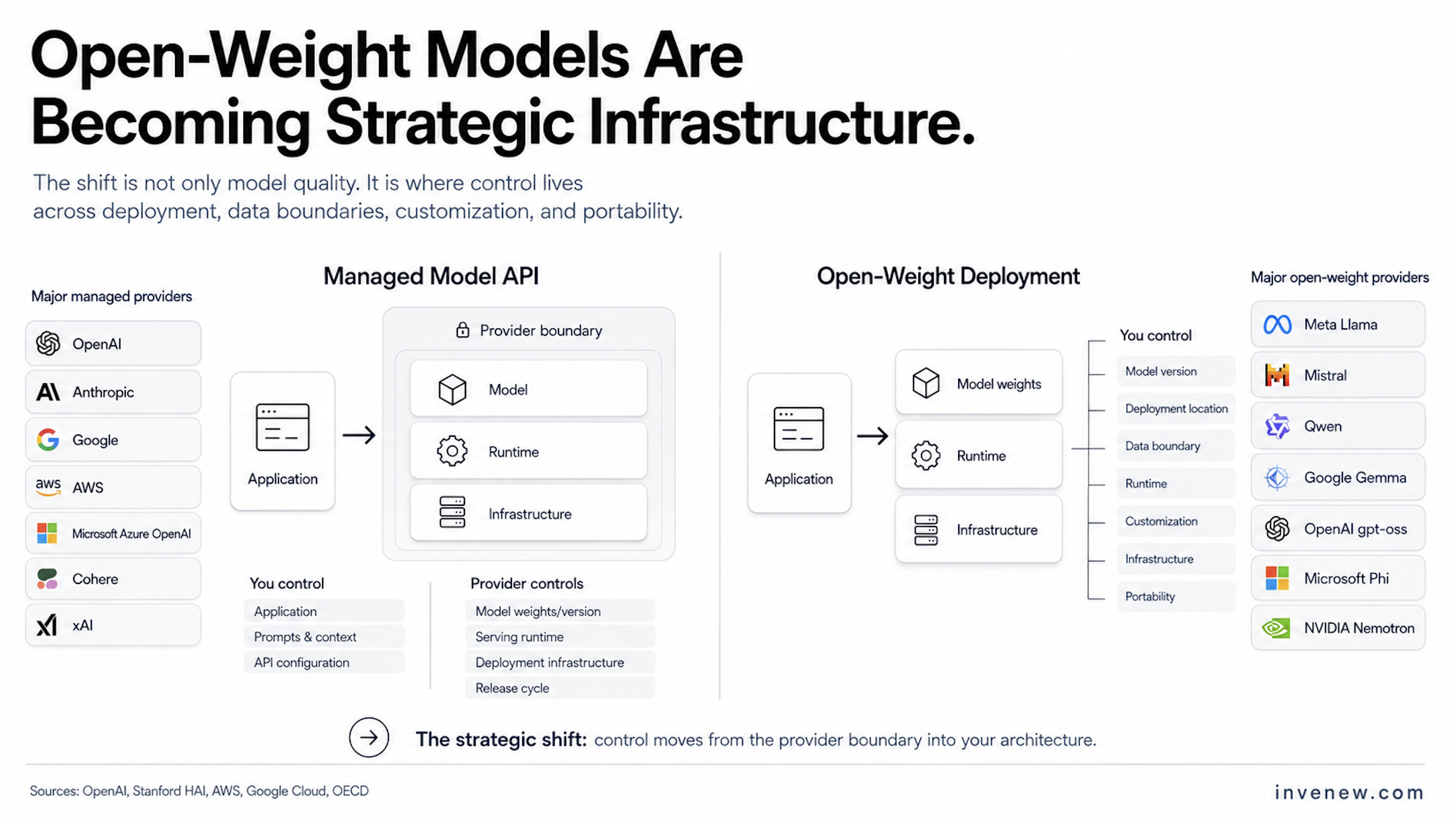
What moves inside your control boundary
With a conventional managed model API, the application sits on your side of the boundary while the provider generally operates the model and serving system.
You control your application, prompts, context, tools, retrieval, and API configuration.
The provider controls much of the model serving environment, including the deployed model artifact, inference runtime, infrastructure, and service release process.
When you self-deploy an open-weight model, more of that stack can move inside your architecture.
Model version. You can pin a particular model artifact and decide when to test or replace it.
Deployment location. Subject to hardware and software requirements, the model can run in your cloud account, private infrastructure, data center, edge environment, or local hardware. OpenAI, for example, describes gpt-oss as designed to run locally and in data centers.
Data boundary. When inference is actually operated inside trusted infrastructure, prompts and outputs do not need to pass through the model developer’s hosted inference service. Stanford notes that open-weight models can be run outside their creators’ infrastructure, although using a third-party hosted API changes that data-control picture.
Customization. Google explicitly allows Gemma weights to be modified through fine-tuning, while OpenAI permits gpt-oss users to customize or fine-tune the models.
Serving architecture. You can choose the runtime, hardware profile, scaling strategy, observability, and surrounding controls rather than taking them entirely as part of a model service.
Portability. If the application is designed around replaceable model interfaces and validated alternatives, the organization can reduce dependence on one inference provider.
None of these benefits arrives automatically because a model is open-weight. They become available when the deployment architecture is designed to use them.
Why this is becoming infrastructure
The model used to look like an external capability.
Call an endpoint. Receive an answer.
Open weights turn the model into something closer to a deployable infrastructure artifact.
It can be versioned. Evaluated. Stored. Moved. Optimized. Wrapped with policy. Connected to a chosen runtime. Deployed into a chosen trust boundary.
That changes what the organization can own.
It also creates new responsibilities.
Someone now has to operate inference capacity, patch the serving stack, monitor resource use, manage model versions, secure the environment, validate upgrades, and maintain evaluation coverage.
Control is useful only when the value of that control exceeds the cost of operating it.
That is why “open versus closed” is the wrong decision framework.
The real question is:
Which workloads benefit enough from model and deployment control to justify bringing more of the stack inside the operating boundary?
When open-weight deployment becomes attractive
Start with the workload, not the model family.
Open-weight deployment deserves serious evaluation when one or more constraints materially affect the system:
Sensitive information needs to remain inside a defined infrastructure boundary.
A fixed model version matters for validation, reproducibility, or operating stability.
Fine-tuning produces meaningful task-specific improvement.
Workload volume makes self-operated inference economically worth testing.
Deployment location matters because of latency, residency, disconnected operation, or infrastructure requirements.
Dependence on one inference provider creates material operational or commercial risk.
This is also where the infrastructure lens becomes important.
A small application may need only one model running on one endpoint.
A platform supporting many applications may also need shared serving, access controls, quotas, model routing, observability, tenant isolation, cost allocation, version governance, and a formal upgrade process.
The weights are only one layer of the system.
Where the managed API still wins
More control is not automatically better architecture.
A managed API remains a strong choice when the workload depends on frontier capability, usage is uncertain, infrastructure ownership adds little business value, or the team cannot justify running a model-serving operation.
Managed services also remove large amounts of work. Capacity planning, hardware provisioning, inference optimization, availability, and much of the serving lifecycle remain someone else’s problem.
The fact that you can operate a model yourself is not a reason to do it.
A useful architecture keeps that decision reversible.
The Move
Pick one production workload where control might have measurable value.
Run the current managed model and one credible open-weight alternative through the same evaluation.
Measure more than output quality.
Compare latency, operating cost, infrastructure requirements, failure behavior, deployment constraints, customization benefit, upgrade effort, and the amount of operational ownership each option creates.
Then ask one question:
Does bringing the model inside our control boundary solve a problem important enough to own the additional infrastructure?
If the answer is no, keep the managed API.
If the answer is yes, open weights have stopped being a model experiment.
They have become infrastructure.
Worth reading
Stanford HAI’s “Open-Weight Models Aren’t Enough. We Need Truly Open Source AI Models for Science and Society” is useful because it separates access to model weights from full transparency into training data and development methods. That distinction is important when evaluating what “open” actually gives an operator.
Takeaways
Open-weight describes access to the model artifact. It does not describe where inference is running.
Managed versus self-operated is a separate architectural decision.
Self-deployed open weights can increase control over model version, deployment location, data boundaries, customization, runtime, and infrastructure.
Control creates operating responsibility. The team now owns more of the inference lifecycle.
The decision should be workload-specific. Move a workload only when control provides measurable technical, economic, regulatory, or strategic value.
The durable architecture keeps model choice revisitable. Avoid making either a managed API or a self-hosted model harder to replace than the application requires.

Reply: Where would additional model control create the most value in your environment today?
If this helped you, leave a comment or your reaction. I’d like to hear where you landed.
INVENEW exists to help tech builders, operators, founders, and leaders turn AI from experiments into working systems.
In partnership with AWS
Sponsored link – Webinar: Redefining application and API security in the age of AI. See how to embed security early, align with compliance expectations, and discover AWS Partner solutions in AWS Marketplace.
Note: Third-party company and product names belong to their respective owners and are used for identification and illustrative reference only.