

In This Issue
Why open-weight models are gaining usage while proprietary providers continue to capture most spending.
What “open” actually means, and why downloadable weights do not guarantee freedom from restrictions.
Where each ecosystem offers a practical advantage.
How to choose your model, hosting, and application dependencies without unnecessary lock-in.
The signal: the AI market is splitting by workload
The debate over open versus proprietary AI used to focus mainly on model quality. Could an openly available model perform as well as one from a leading commercial lab?
That question still matters. But production usage now tells a more complicated story.
According to Vercel's October 2026 AI Gateway Production Index, open-weight models handled 71.5% of tokens routed through its gateway in September, while accounting for approximately 23% of estimated spending.
Over the same period, the average price per token fell 47% compared with December, while gateway spending grew approximately thirteenfold.
These are measurements from Vercel's gateway, not the entire AI market. Spending is estimated using published prices, and the open-weight classification reflects Vercel's model catalog.
Even with those limitations, the pattern is important.
AI applications are consuming more inference while teams increasingly distribute their workloads across models. Lower-cost models can handle large volumes of routine processing. More expensive models continue to attract spending where their additional capability is valuable.
Open models are not simply replacing proprietary models. They are expanding the number of economically viable ways to build AI applications.
The question for a builder is no longer which ecosystem will win.
It is which ecosystem should own each part of the application.
What open and proprietary actually mean
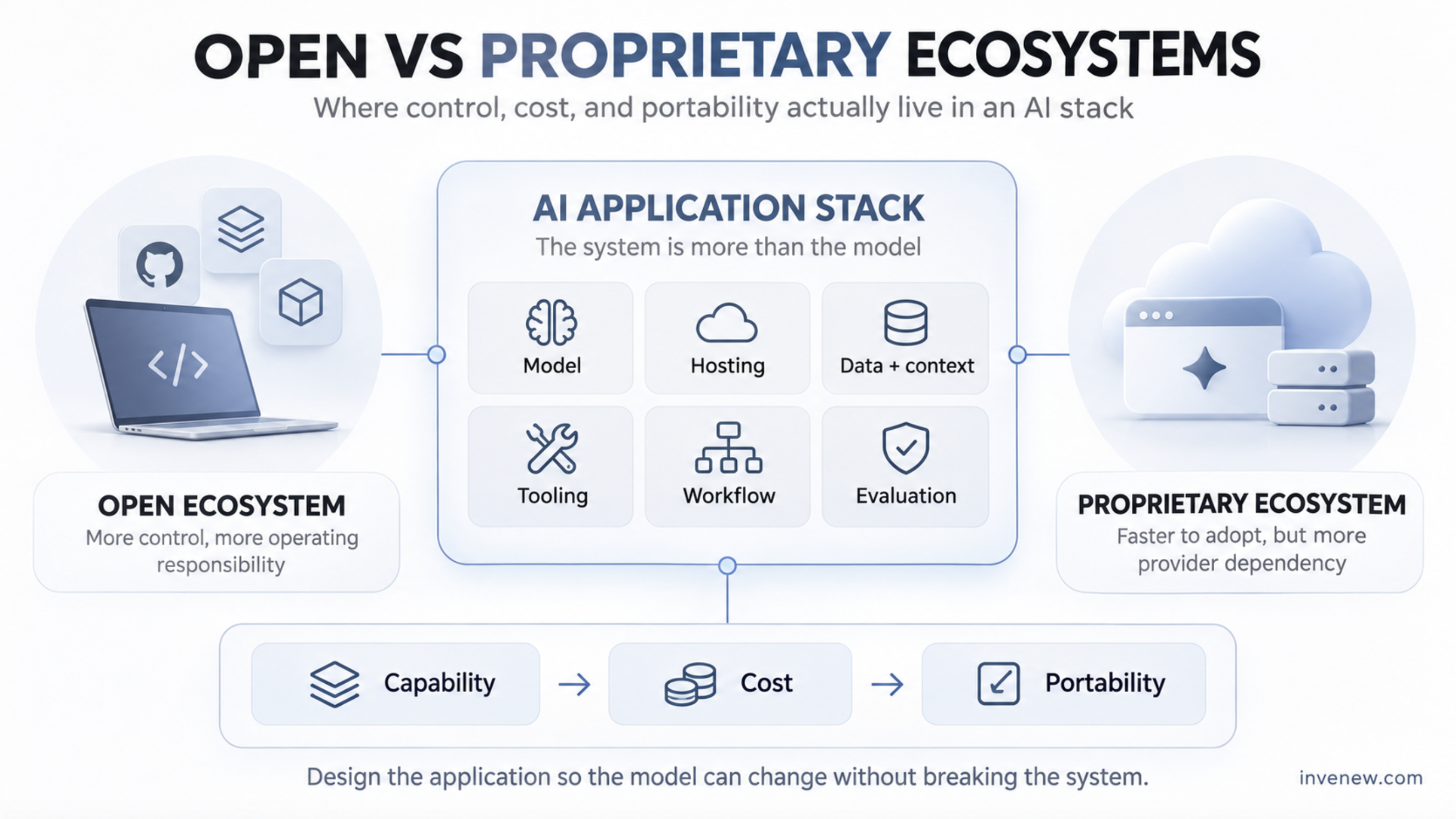
An AI ecosystem includes much more than the model generating an answer.
It includes model access, inference infrastructure, development tools, evaluation systems, security controls, monitoring, commercial terms, and the surrounding services an application depends on.
Three distinctions matter.
Proprietary models are generally accessed through a provider-controlled API or product. The provider operates the underlying model infrastructure and determines access, supported features, pricing, and release schedules.
Open-weight models make trained model parameters available under specified terms. Depending on the license, teams may download, adapt, and deploy those models on their own infrastructure or through a hosting provider.
Open-source AI carries a stronger meaning. Under the Open Source Initiative's definition, the required freedoms include using, studying, modifying, and sharing the system, supported by appropriate code, parameters, and training-data information.
Downloadable weights alone do not establish that a model meets this definition.
This distinction is especially important for commercial applications. A model may permit local deployment while restricting certain uses, redistribution, or derivative works.
There is another important distinction: an open-weight model does not require self-hosting.
A team can consume an open-weight model through a managed inference service. This preserves much of the simplicity of an API while potentially providing more choice over the model or serving provider.
Conversely, a proprietary API can be part of a well-designed, portable application.
Openness and portability are related, but neither automatically guarantees the other.
Why proprietary ecosystems remain attractive
Proprietary providers continue to offer strong reasons for adoption.
The first is capability.
Artificial Analysis updated its Intelligence Index on October 27, 2026. Its new evaluation suite places greater weight on private or held-out tests and reports a meaningful gap between leading proprietary models and released open-weight alternatives.
The exact gap depends on the benchmark and model, and a composite score does not predict every application's performance.
Still, teams building complex coding agents, difficult analytical workflows, or applications requiring advanced multimodal capabilities should not assume that lower-cost alternatives will deliver equivalent results.
The second advantage is reduced operating responsibility.
A managed API usually removes the need to provision accelerators, configure model-serving infrastructure, manage capacity, or maintain inference software.
That matters when a team has limited engineering time.
Proprietary providers may also offer integrated tools for structured responses, tool calling, safety controls, observability, and enterprise administration.
The trade-off is dependence.
The provider can change model behavior, pricing, rate limits, available features, or supported versions. An application that relies heavily on provider-specific tools may become expensive to migrate even when another model can produce similar answers.
The application inherits part of the provider's roadmap.
Why open-weight ecosystems are becoming more practical
Open-weight models offer a different set of advantages.
Teams can potentially choose where inference runs, customize models for particular tasks, retain approved versions, and negotiate across hosting providers.
This creates opportunities for applications with high request volumes, specialized data requirements, or predictable workloads.
Consider a product that processes thousands of customer documents every day.
Its tasks might include extraction, classification, summarization, and identifying exceptions.
Some of those operations may not require the strongest available model. A smaller open-weight model, properly evaluated and deployed, might provide acceptable accuracy at a lower unit cost.
But the savings are not automatic.
Self-hosting introduces infrastructure utilization, hardware, engineering, monitoring, security, upgrades, and incident-response costs. A model that is inexpensive per token on a fully utilized accelerator may become expensive when demand is inconsistent.
The deployment market is also evolving.
Microsoft, for example, introduced managed compute for serving and customizing open models in Microsoft Foundry in June 2026. This illustrates how open-weight deployment is becoming a service that organizations can buy, rather than an infrastructure capability every team must build.
The ecosystem is increasingly separating model development from model hosting.
That separation can improve choice. It can also introduce a new dependency on the company operating inference.
The real decision: where should control live?
The most useful comparison is not a list of model vendors.
It is a comparison of the responsibilities and dependencies a team is willing to accept.
Decision | Proprietary API | Open-weight ecosystem |
|---|---|---|
Model operation | Usually managed by provider | Self-hosted or managed |
Model customization | Provider-supported options | Potentially deeper control |
Infrastructure responsibility | Generally low | Depends on hosting choice |
Model version control | Subject to provider policy | Greater control when self-hosted |
Commercial rights | Service agreement | Model license plus hosting terms |
Switching costs | API and feature dependencies | Runtime, deployment, and tooling dependencies |
Neither column automatically guarantees lower cost, stronger privacy, better security, or higher reliability.
Those outcomes depend on the specific model, provider, contract, and implementation.
For most application teams, the practical starting point is to retain control of the application's data, workflow logic, evaluation criteria, and operational records.
Those are the assets that make switching possible.
The model can then become a replaceable component instead of the organizing center of the application.
A practical selection method
Before committing to an ecosystem, test one real production workflow.
1. Define the required outcome.
Specify the task, acceptable errors, latency requirement, data sensitivity, and expected volume. Do not begin with a favorite model.
2. Compare three deployment options.
Test a proprietary API, a managed open-weight model, and a self-hosted open-weight model only if operating your own infrastructure is realistic.
3. Evaluate complete task cost.
Include retries, failed outputs, tool calls, human review, infrastructure, and maintenance. Token price by itself is insufficient.
4. Test the difficult cases.
Build an evaluation set containing representative failures, ambiguous inputs, large requests, and cases requiring human approval.
5. Check the dependency surface.
Identify provider-specific APIs, embeddings, stored conversation state, tool definitions, monitoring, fine-tuning artifacts, and data-export requirements.
6. Document a migration path.
Verify that another approved model can process the same input and produce an output your application can validate.
A small abstraction layer can help, but portability requires more than exchanging one model name for another. Prompt behavior, context limits, structured outputs, latency, and failure patterns still need evaluation.
When to favor each approach
A proprietary ecosystem is often the sensible starting point when capability requirements are high, demand is uncertain, and the team needs to reach production without managing inference.
A managed open-weight model deserves serious consideration when the task is repeatable, model quality is sufficient, and pricing or hosting flexibility matters.
Self-hosting becomes more attractive when sustained volume, deployment constraints, customization, or operational independence justify the additional engineering burden.
Many applications will use all three patterns.
For example, a customer-support workflow could use a lower-cost model to categorize requests, a stronger proprietary model to handle difficult reasoning, and deterministic application logic to authorize account changes.
The architecture should make the boundaries explicit.
No model should be given control over a business action simply because it generated a plausible response.
The move: make the ecosystem decision reversible
Choose one workflow that currently depends on a single model provider.
Create a one-page model dependency record containing:
The task and quality threshold.
The current model and provider.
The data sent to the model.
The provider-specific features in use.
The expected monthly workload and complete cost.
The alternative model tested.
The conditions that would trigger a switch.
Then run the same evaluation set against at least one alternative.
You do not need to migrate immediately.
The first objective is to know whether migration is practical, what quality would change, and which dependencies would prevent it.
That knowledge should become part of the workflow before the application grows around a single provider.
Worth reading
The report offers a useful production-traffic view of open-weight adoption, spending, falling token prices, and model switching. Its findings are specific to workloads routed through Vercel AI Gateway rather than the whole market.
Takeaways
For builders: Keep business logic, evaluation, and data ownership outside model-specific integrations wherever practical. Test alternatives against actual application tasks before committing.
For operators: Measure reliability, latency, utilization, support, and incident burden alongside token prices. Cheaper inference does not necessarily mean a cheaper service.
For leaders: Treat model sourcing as a portfolio decision. Pay for advanced capability where it changes outcomes, and seek lower-cost or more controllable options where the workload permits.
The enduring advantage is not choosing the winning model ecosystem.
It is building an application that can benefit when the ecosystem changes.
A question for you: What would be hardest to replace in your current AI stack: the model, its hosting provider, or the tools built around it?
If this helped you, leave a comment or your reaction. I’d like to hear where you landed.
INVENEW helps tech builders, operators, founders, and leaders turn AI from experiments into working systems.
Sponsored
🧩 Upgrading your model to fix AI accuracy is a bit like buying a faster car because you keep getting lost.
In AtScale’s preliminary BIRD-Interact runs, adding a semantic layer raised accuracy by about 20 points on average, more than switching to the best model did.
The AI Accuracy Flywheel turns every wrong answer into a test and sends the correction back into the model, so the same mistake doesn’t come back.
Join Mark Palmer, Daniel Gray, and Andrew Brust of Blue Badge Insights on November 18 as they walk through each stage of the flywheel.
🎥 Register for the webinar, Wednesday, November 18 at 2 pm ET
Note: Third-party company and product names belong to their respective owners and are used for identification and illustrative reference only.