

In This Issue
Why adding a reviewer does not automatically make an AI workflow safer.
The conditions required for a review step to function as a real control.
Where approval belongs when consequences, uncertainty, and reversibility differ.
How excessive review creates delay without improving decisions.
A practical test for removing ceremonial approval steps.
“Keep a human in the loop” sounds like a complete control.
It rarely is.
A person may be shown an AI-generated answer without seeing its sources. An approver may receive a recommendation after the consequential action has already occurred. A reviewer may be able to reject an output without knowing what happens after rejection.
The workflow contains a human, but the person cannot reliably change the outcome.
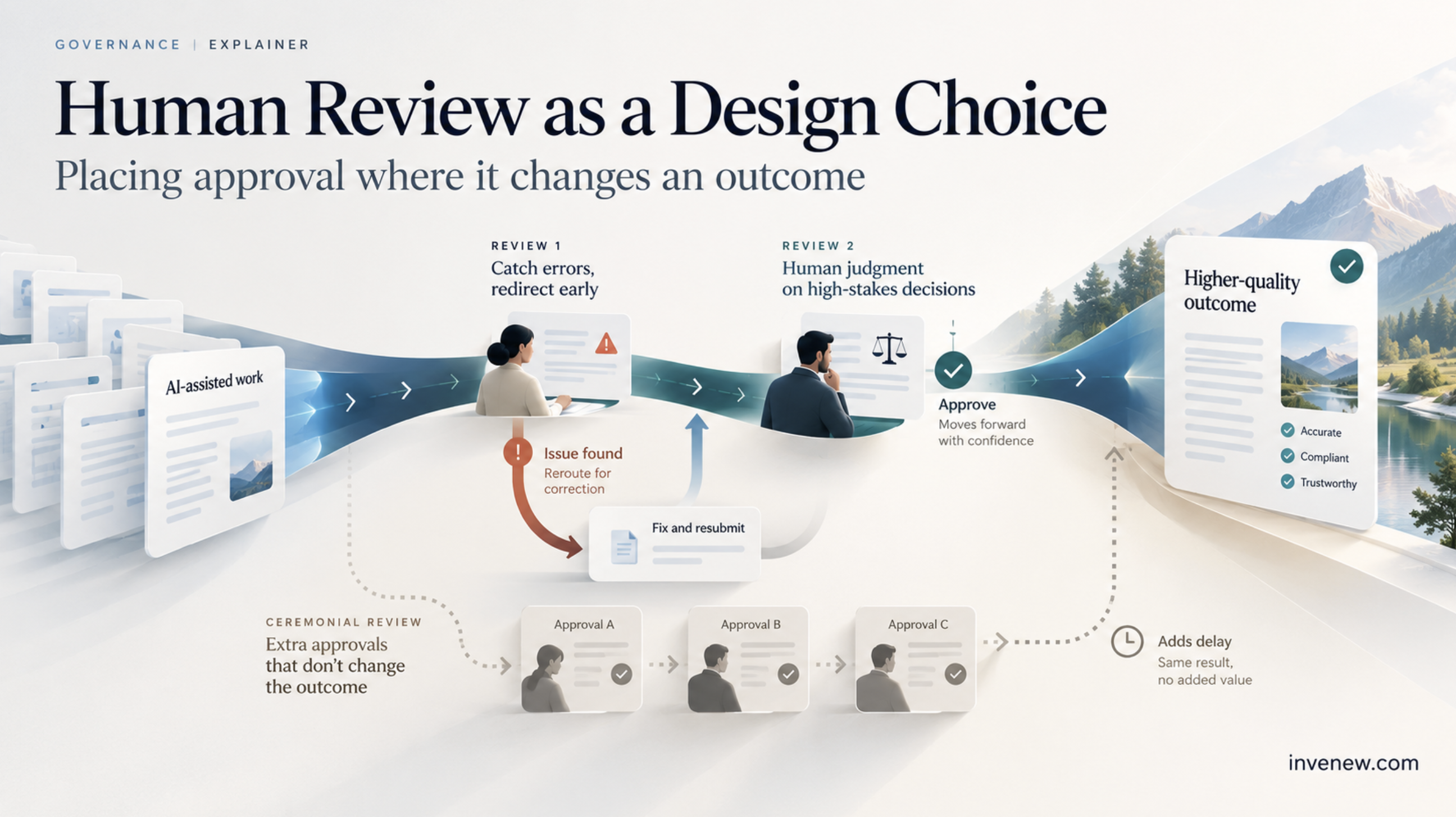
Human review works only when it is designed around a specific decision. The reviewer must receive the evidence needed to judge that decision, have authority to intervene, and act before the consequence becomes difficult to reverse.
Without those conditions, review becomes ceremony. It records human presence without establishing human control.
Human review is part of the system
Human review is often added after the automated workflow has been designed.
The system generates an answer, selects an action, or prepares a transaction. A review screen is then placed before the final step. This appears to reduce risk because the workflow no longer operates autonomously.
But the design of the review step determines whether that claim holds.
A meaningful review point must specify:
What decision the person is making.
What information the person receives.
Which errors the person is expected to detect.
What actions the person can take.
What happens when the person does nothing.
How the decision is recorded and later examined.
“Human approval required” defines none of these.
The reviewer may need to confirm facts, interpret policy, judge an exception, authorize an external action, or accept residual risk. Those are different jobs. Combining them into a single approve-or-reject button obscures what the control is supposed to accomplish.
Start with the outcome that can change
The first design question is straightforward:
What can this reviewer change?
If the answer is only “approve or reject,” continue asking.
Can the reviewer correct the source data? Change a recommendation? Remove one action from a larger plan? Request additional evidence? Escalate the case? Choose a safer alternative? Stop execution?
A review step earns its place when it creates a real branch in the workflow.
Consider an AI system that drafts a customer response. Reviewing the wording before sending can change the outcome because the reviewer can edit or withhold the message.
Now consider a system that updates a customer record, triggers a billing adjustment, and then asks someone to review the generated explanation. The person can improve the explanation, but the consequential action has already happened. The review sits beside the decision rather than controlling it.
Placing a person near an automated action does not establish oversight. The intervention must occur at the point where the outcome remains changeable.
Match review to consequence and reversibility
Not every AI-assisted action needs individual approval.
Review intensity should rise with the consequence of an error and the difficulty of reversing it. A low-impact, easily corrected action may need monitoring and periodic sampling. A high-impact, irreversible action may require explicit approval before execution.
Consequence | Reversibility | Appropriate control |
|---|---|---|
Low | Easy | Automated execution with logging and sampled review |
Low | Difficult | Pre-execution validation or targeted approval |
High | Easy | Rapid review, monitoring, and a tested correction path |
High | Difficult | Explicit approval before execution, with evidence and escalation |
The same AI output may require different controls depending on how it is used.
A model can summarize a policy for an internal researcher with limited consequence. If the same summary determines whether a customer receives a service, the decision requires stronger evidence, authority, and documentation.
The risk belongs to the use of the output, not to the output format.
Give the reviewer evidence, not just an answer
A reviewer cannot evaluate what the interface hides.
Showing the generated result alone encourages surface-level acceptance. The reviewer sees whether the answer appears plausible, complete, and professionally written. Those qualities provide little evidence that the underlying decision is correct.
The review interface should expose the information needed for the assigned judgment. Depending on the workflow, that may include:
The source records used.
The applicable policy or rule.
Important assumptions.
Missing or conflicting information.
Actions the system intends to take.
Material changes from the previous state.
Known limits of the model or workflow.
The reason the case was sent for review.
More information is not always better. A screen crowded with logs and technical traces can hide the evidence that matters.
The design goal is decision sufficiency: enough information for this reviewer to make this decision, presented in a form the reviewer can understand within the available time.
A reviewer who cannot alter execution is an observer.
Authority includes the ability to stop, correct, defer, narrow, or escalate an action. It also requires the surrounding organization to respect those choices.
A nominal approver may still lack effective authority when rejection creates excessive additional work, delays a customer without an escalation path, or is treated as evidence that the reviewer is obstructing automation.
The workflow should make the safe action operationally possible.
For each review point, define:
Who may approve.
Who may reject.
Who may modify the proposed action.
When escalation is required.
What happens when reviewers disagree.
What happens when nobody responds.
Which decisions require a second authority.
These rules belong in application logic and operating procedures. A prompt telling the model to “ask for human approval” cannot enforce them.
Review exceptions instead of everything
Reviewing every output can feel safer because nothing appears to bypass a person. At sufficient volume, however, repeated approval becomes a queue.
Reviewers learn that most cases are routine. Attention declines. Approval becomes the expected action, and unusual cases arrive inside a stream of ordinary ones.
A better design routes attention according to risk.
A case might require review when:
The requested action exceeds a value or permission threshold.
Required evidence is absent or contradictory.
The system encounters a new type of input.
Sensitive data or a protected decision is involved.
The proposed action conflicts with policy.
Multiple systems produce materially different answers.
The action cannot be reversed cheaply.
A user disputes the result.
Routine cases can proceed under deterministic controls, monitoring, and sampling. Review capacity stays available for decisions where judgment can add value.
Selective review also creates a clearer design obligation. The team must define why a case deserves attention instead of relying on human presence as a general substitute for system controls.
Separate approval from evaluation
Approval decides whether a specific action may proceed. Evaluation determines whether the system performs well enough across many cases.
The two functions support each other, but one cannot replace the other.
A reviewer approving individual transactions may catch isolated problems while missing a repeated pattern. A periodic evaluation may reveal that one category of users receives worse recommendations even though each result looked reasonable in isolation.
A complete oversight design may include:
Pre-execution approval for consequential cases.
Exception handling when rules or evidence conflict.
Sampled review of routine outputs.
Aggregate evaluation across outcomes and user groups.
Post-incident review when controls fail.
Appeals for people affected by a decision.
The placement of each control should follow the decision it is meant to influence.
Watch for automation bias
Human review can create false confidence when the reviewer assumes the system has already completed most of the reasoning.
The polished output arrives first. The reviewer’s job appears to be confirming it. This framing can anchor the person to the system’s conclusion.
Design can reduce that pressure.
For higher-consequence decisions, ask the reviewer to record an independent judgment before revealing the AI recommendation. Where that is impractical, display the underlying evidence and unresolved questions before presenting the proposed action.
Avoid confidence scores unless they have been calibrated for the actual task and the reviewer understands what they measure. A number such as “92% confidence” can influence judgment even when it does not represent a 92% probability of correctness.
The interface should help the reviewer inspect the decision, not persuade the reviewer to accept it.
The move
Take one AI-assisted workflow and list every point where a person currently reviews, confirms, or approves something.
For each point, complete this review contract:
Define | Question |
|---|---|
Decision | What exactly is the reviewer deciding? |
Consequence | What happens if the reviewer is wrong? |
Evidence | What must the reviewer see to judge correctly? |
Authority | What can the reviewer stop, change, or escalate? |
Timing | Does review happen while the outcome is still reversible? |
Default | What happens if the reviewer does nothing? |
Record | What decision, reason, and evidence must be retained? |
Trigger | Why does this case require review? |
Then apply one test:
If this review step were removed, which decisions or outcomes would change?
If nothing identifiable would change, remove the step or redesign it.
If the review matters, make its function explicit in the workflow. Show the right evidence, give the reviewer sufficient authority, define the response time, and test rejection and escalation paths as carefully as approval.
Human review should consume attention where attention can still change the result.
Worth reading
NIST’s AI Risk Management Framework describes human-AI configurations ranging from fully autonomous to fully manual and emphasizes that roles and responsibilities in decision-making and oversight should be clearly defined. It also recognizes that some systems require human oversight while others may not.
Takeaways
Define the decision assigned to the reviewer.
Place review before the outcome becomes difficult to reverse.
Provide the evidence needed for that particular judgment.
Give the reviewer authority to stop, correct, defer, or escalate.
Route unusual and consequential cases to people instead of reviewing everything.
Use sampled and aggregate evaluation to detect patterns that transaction approval misses.
Remove review steps that cannot be shown to change a decision.
If this helped you, leave a comment or your reaction. I’d like to hear where you landed.
INVENEW exists to help tech builders, operators, founders, and leaders turn AI from experiments into working systems.
Sponsored
SECURITY DEMO → GRC strategies for securing cloud AI: Join experts from Amazon Web Services (AWS) and SANS Institute for a hands-on security demo exploring how to apply governance, risk, and compliance (GRC) strategies across modern AI environments. See approaches for managing identity and agent access, protecting sensitive data, strengthening detection and response, and addressing risk across the AI lifecycle.
Attio is the agentic CRM for modern teams. It’s your always-on revenue engine: agents and workflows build pipeline, chase every buying signal, and move deals forward alongside your team. Try Attio now.
Note: Third-party company and product names belong to their respective owners and are used for identification and illustrative reference only.