

In This Issue
Open-weight models create deployment choice. They do not make self-hosting the default.
A private endpoint changes the network boundary, not necessarily who operates inference.
Hard requirements should eliminate options before cost enters the comparison.
Private networking and dedicated capacity are separate decisions.
The signal
Open-weight models matter partly because they create deployment optionality. When a model's weights and license permit local deployment, a team can choose to run inference on infrastructure it controls rather than depend entirely on a model provider.
That creates the next decision:
Where should inference run, and how much of the stack should you own?
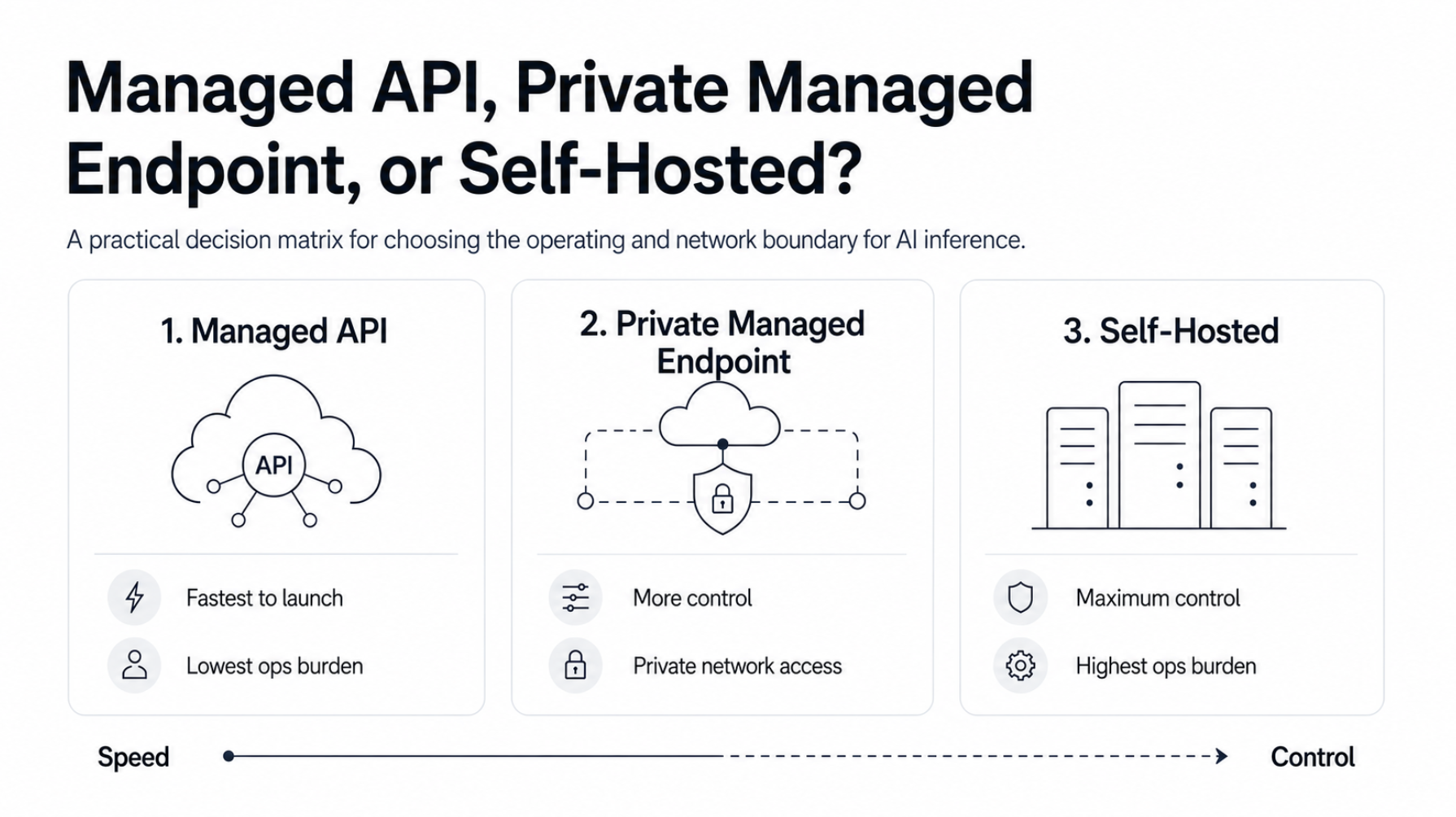
For this comparison, managed API means provider-operated inference reached through the provider's standard service endpoint.
Private managed endpoint means provider or cloud-managed inference reached through private cloud networking.
Self-hosted inference means your team operates the serving runtime on compute you control. That compute can be in a public cloud, private cloud, or your own data center.
The distinction matters because a private endpoint is a networking mechanism, not a competing inference operating model. Amazon Bedrock can be accessed privately through AWS PrivateLink without an internet gateway or NAT device. Microsoft allows public access to an Azure OpenAI resource to be disabled so private endpoints become the access path. Google supports private connectivity to Vertex AI inference through Private Service Connect.
Hugging Face makes the separation especially clear. It describes Inference Endpoints as a managed service where it handles the container lifecycle, scaling, and health monitoring, while PrivateLink can separately restrict endpoint access to a VPC.
So the useful question is not simply cloud versus self-hosted.
It is:
What is the lowest-control deployment boundary that satisfies this workload?
The decision matrix
Decision factor | Managed API | Private managed endpoint | Self-hosted inference |
|---|---|---|---|
Who operates serving | Provider | Provider or cloud service | Your team |
Network access | Standard service endpoint | Private VPC/VNet path | You design it |
Runtime control | Low | Low to medium, service-dependent | High |
Weight access | Usually unavailable | Service and model dependent | Required for the model you deploy |
Scaling | Provider managed | Managed or configurable | Your responsibility |
Dedicated capacity | Sometimes available | Sometimes available | Whatever you provision |
Time to production | Usually shortest | More network/setup work | Usually longest |
Operating burden | Lowest | Low to medium | Highest |
Cost shape | Consumption or provisioned capacity | Consumption, instances, or provisioned capacity | Compute plus the system needed to operate it |
Typical fit | Fast iteration, variable demand, proprietary models | Private connectivity without owning serving | Workloads where runtime or infrastructure control creates enough value |
These are deployment archetypes, not universal product categories. Vendor implementations overlap. The matrix is useful because it separates responsibilities rather than assuming every platform implements them identically.
Eliminate options before comparing price
Start with constraints.
If the model you need is proprietary and available only through a provider, that model cannot be self-hosted.
If policy prohibits use of an internet-accessible service endpoint, private managed inference or self-hosting may still satisfy the requirement. AWS, Microsoft, Google, and Hugging Face all document private-network access patterns for managed inference services.
If your organization must directly control the model weights, serving runtime, or placement of inference, a standard managed API will usually not meet that requirement. The appropriate alternative may be self-hosting or a cloud platform that allows customer-supplied models under the required control boundary.
Sensitive data alone does not automatically mean self-hosting.
Translate "sensitive" into actual requirements: who may process the data, where processing may occur, what retention is allowed, what network path is permitted, and what evidence must exist for audit.
Managed providers can offer controls that matter here. OpenAI, for example, states that API business data is not used for model training by default, and qualifying organizations can request zero data retention for eligible endpoints. Whether those controls satisfy a specific regulatory or contractual obligation remains a workload-specific decision.
When a managed API wins
Start here when speed of learning matters more than infrastructure control.
A managed API is usually attractive when demand is uncertain, the product is still being validated, or the required model is proprietary. The provider carries most of the inference infrastructure responsibility.
That leaves the application team focused on the workflow, evaluation, product behavior, and integration.
The trade-off is dependency. The provider controls the available models, service limits, pricing structure, deployment options, and many runtime behaviors.
That is often acceptable early. It becomes more important as the workload grows or becomes harder to move.
When a private managed endpoint wins
Use this option when the constraint is mainly network isolation or cloud access architecture, but there is no reason to operate the inference stack yourself.
A private managed endpoint can keep application-to-model traffic on private cloud networking while preserving managed serving. AWS PrivateLink, Azure private endpoints, Google Private Service Connect, and Hugging Face PrivateLink demonstrate variations of this pattern.
But one distinction matters:
Private does not mean dedicated.
Private networking answers:
How does traffic reach the service?
Provisioned capacity answers:
Is processing capacity reserved for the workload?
These are independent choices.
Microsoft Foundry provisioned throughput reserves dedicated model-processing capacity for a deployment. Amazon Bedrock offers Provisioned Throughput separately from its networking controls and bills that capacity hourly. Google similarly separates pay-as-you-go usage from reserved Provisioned Throughput.
A system can therefore have private connectivity without dedicated capacity. It can also use dedicated managed capacity without becoming self-hosted.
When self-hosting wins
Self-host when control over inference creates enough value to justify operating another production system.
That value may come from model placement, fixed model versions, runtime customization, quantization, hardware selection, deeper performance tuning, or the need to run in an environment a managed provider cannot satisfy.
Modern inference engines make this increasingly practical. vLLM provides an OpenAI-compatible HTTP server, supports distributed tensor and pipeline parallel inference, data-parallel deployment, and multiple quantization mechanisms.
But those capabilities also show what self-hosting transfers to your side of the boundary.
Your team now owns GPU capacity, scaling, runtime upgrades, failure recovery, monitoring, security maintenance, performance tuning, and operational response.
Access to open weights creates the option. It does not remove the operating work.
Do not compare token price with GPU price
This is where many deployment comparisons become misleading.
A provider's token price and a GPU's hourly price represent different cost structures.
Compare the cost of delivering the same successful workload.
Use the same evaluation set and representative traffic. Measure quality, latency, throughput at expected concurrency, failures or throttling, and total serving cost.
Then include the costs each architecture hides differently.
For self-hosting, that includes idle compute, peak headroom, redundancy, storage, networking, observability, engineering time, and operating ownership.
For managed inference, include any reserved-capacity commitment. Microsoft notes that provisioned throughput capacity is billed whether requests are being processed or not. AWS bills Bedrock Provisioned Throughput hourly. Hugging Face managed endpoints can scale to zero, which lowers idle cost but introduces a cold-start period.
This is why there is no defensible universal request volume or token threshold at which self-hosting suddenly becomes cheaper.
The crossover depends on the model, hardware, workload shape, utilization, reliability target, and operating cost.
Benchmark the workload rather than relying on a generic calculator. vLLM provides dedicated tools for benchmarking serving latency and throughput precisely because serving performance changes with workload and configuration.
The move
Use the lowest-control architecture that satisfies every hard requirement.
Start with managed inference when it clears the requirements and lets you learn faster.
Add private managed access when the network boundary needs to change, but operating inference yourself adds no useful advantage.
Self-host when control over the runtime, model, placement, or economics becomes important enough to justify owning the additional system.
Then preserve the ability to change the answer later.
Keep model access behind an application interface. Keep your evaluations separate from the provider. Record model and serving configurations. Avoid spreading provider-specific assumptions throughout the application.
OpenAI-compatible serving interfaces such as vLLM can reduce API migration work, but interface compatibility does not make two models behaviorally equivalent. Any model or deployment change still needs to pass the same evaluation workload.
That is the more useful consequence of open weights.
They do not tell you to self-host.
They give you another credible place to move.
Worth reading
Microsoft's documentation on provisioned throughput for Foundry Models is useful because it clearly separates ordinary shared-capacity inference from dedicated model-processing capacity. That distinction helps prevent private networking, dedicated capacity, and self-hosting from being collapsed into one decision.
Takeaways
Private endpoint is a network decision. It is not the opposite of a managed API.
Private networking and dedicated capacity are separate controls.
Self-hosting means operating the inference runtime. It does not require owning the physical hardware.
Apply hard constraints before comparing cost. Security, model access, placement, and operating requirements can eliminate options immediately.
There is no universal self-hosting break-even point. Benchmark the actual workload against the same quality and service targets.
Preserve deployment optionality. The right architecture today may not be the right one at a different scale.

Reply: Which constraint is most likely to change your inference deployment choice: network isolation, model control, capacity, data requirements, or cost?
If this helped you, leave a comment or your reaction. I’d like to hear where you landed.
INVENEW exists to help tech builders, operators, founders, and leaders turn AI from experiments into working systems.
In partnership with AWS
Sponsored link – Webinar: Redefining application and API security in the age of AI. See how to embed security early, align with compliance expectations, and discover AWS Partner solutions in AWS Marketplace.
Note: Third-party company and product names belong to their respective owners and are used for identification and illustrative reference only.