

In this issue
Why inference matters once an AI application reaches production.
The inference lifecycle, from prompt and tokenization to streamed response.
Why prefill and decode place different demands on compute and memory.
The main components of a production inference platform.
The techniques and trade-offs that shape speed, reliability, privacy, and cost.
Every interaction with a deployed AI model involves inference.
A user asks a question, uploads a document, submits code, or triggers a workflow. The application sends input to a model, the model processes it, and the resulting output is returned to the user or another system.
The interaction feels simple. Underneath, a production system may coordinate models, accelerators, memory, networking, routing, scheduling, caching, observability, and security controls.
Understanding inference matters because this is where a trained model becomes a usable service. For applications serving ongoing traffic, inference also becomes a recurring operational workload whose cost grows with request volume, input length, output length, model size, and service requirements.
Training creates the model. Inference applies it.
Models are trained by processing data and adjusting their parameters. They may later be fine-tuned, post-trained, or updated.
Inference begins when a trained model is used to generate a prediction or response.
During standard inference, a user prompt does not directly update the model’s weights. The model applies what it has already learned to the supplied input. The surrounding application may still store conversation history, retrieve external information, or retain interactions for later evaluation and improvement.
For a large language model, the response is generated as a sequence of tokens.
A request begins a chain of events
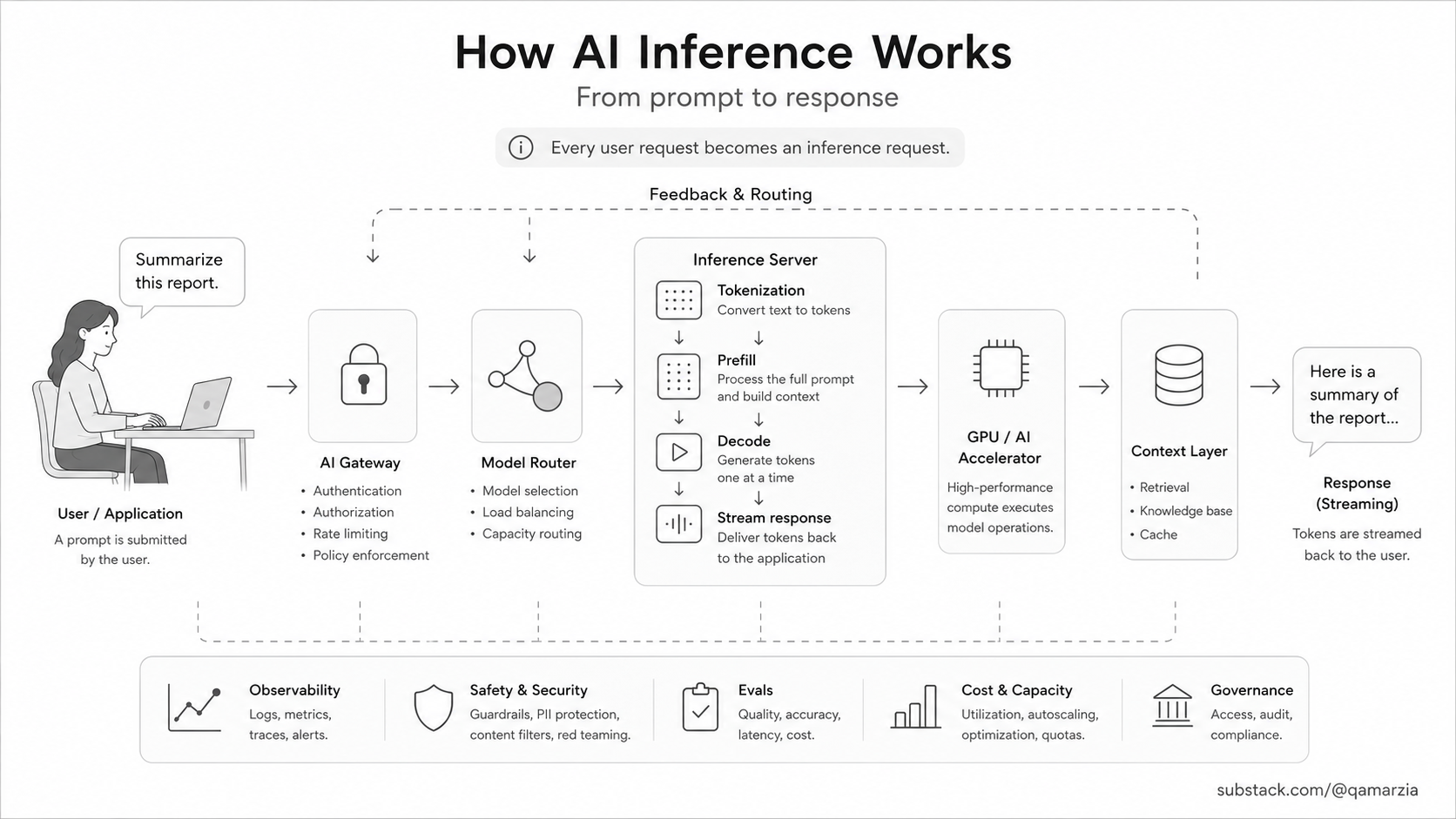
A typical request may follow this path:
The application receives the request.
Authentication, authorization, and policy controls are applied.
Relevant context or documents may be retrieved.
A router selects a model and available serving capacity.
The text is converted into tokens.
The model processes the input during prefill.
The model generates output tokens during decode.
Tokens are streamed back to the application.
Metrics, traces, costs, and policy outcomes are recorded.
The exact sequence varies. A simple application may call one hosted model API directly. A larger platform may route traffic across several models, regions, and serving pools.
Prefill and decode perform different work
Inference has two main computational phases.
The prefill phase processes the prompt, system instructions, retrieved context, and conversation history. It is often compute intensive, especially for long inputs.
The decode phase generates new tokens one at a time. It often places greater pressure on memory capacity and memory bandwidth because model weights and cached attention data must be accessed repeatedly.
This distinction helps explain why long prompts increase time to first token and why generation speed depends heavily on memory efficiency.
Inference can become a distributed system
A production inference platform may include:
Application
AI gateway
Retrieval and context layer
Model router
Inference server
GPU or AI accelerator pool
Caching
Observability and evaluation
Security and governance controls
A small application may use only a few of these components. Larger systems add them as traffic, reliability, privacy, and operational requirements increase.
Replacing one model with another rarely solves performance problems when the surrounding architecture remains poorly designed.
Scaling depends on orchestration as well as hardware
As demand grows, requests must be queued, routed, balanced, and scheduled across available capacity.
Different models may serve different workloads. Systems must recover from failures. Capacity may need to expand during peaks and contract when demand falls.
The goal is not maximum GPU utilization by itself. The goal is to meet latency, throughput, reliability, quality, and cost targets together.
The main trade-offs
Every inference platform balances related priorities:
Latency and throughput
Model quality and resource demand
Privacy and deployment control
Cost and available capacity
Simplicity and operational flexibility
There is no universal best architecture. The right design depends on workload characteristics, business requirements, and operational constraints.
Where optimization happens
Common techniques include:
Quantization to reduce memory use
Continuous batching to improve accelerator utilization
Prefix and KV-cache reuse to avoid repeated computation
Speculative decoding to improve generation speed in suitable workloads
Model routing to match requests with the right model
Autoscaling to adjust serving capacity as demand changes
These techniques can improve performance or reduce cost, but their effect must be measured against the actual model, hardware, and workload.
The reference architecture

A practical high-level request path is:
User or system → Application → AI Gateway → Retrieval and Context Layer → Model Router → Inference Server → Accelerator Pool → Streamed Response
The following capabilities operate across the path:
Caching → Observability → Evaluation → Security → Governance → Cost and Capacity Management
Each component should exist because the workload requires it, not because it appears in a reference diagram.
Why it matters
Most AI discussions focus on models.
Production performance depends on the complete inference path.
Teams that understand inference architecture make better decisions about latency, throughput, capacity, privacy, reliability, and cost.
Training gives a model its capabilities. Inference architecture determines how consistently and economically those capabilities reach users.
Builder takeaway
Design inference around the workload before choosing the model or infrastructure.
Start with expected request volume, prompt length, output length, latency targets, privacy needs, and acceptable cost. Then decide which model, serving pattern, caching strategy, and deployment option fit those requirements.
Operator takeaway
Measure the full inference path, not only GPU utilization.
Track time to first token, inter-token latency, throughput, queue depth, errors, cache behavior, model quality, and cost per request. Most production problems appear in routing, scheduling, context assembly, memory pressure, or capacity management before they appear in the model itself.
INVENEW exists to help tech builders, operators, founders, and leaders turn AI from experiments into working systems.
In partnership with
AI Insights. Real Growth. Higher GMV, Better Profits

The difference between growing stores and stagnant ones isn't more effort. It's better insights. StoreClaw analyzes your Shopify and Amazon data, surfaces your biggest growth opportunities, and helps you increase GMV while protecting profit. Start free with bonus tokens. No credit card required.
Note: Third-party company and product names belong to their respective owners and are used for identification and illustrative reference only.