

In This Issue
Why governance must begin with systems already in use.
Five layers covering visibility, ownership, human authority, evidence, and continuous governance.
The decisions leaders should make before an incident forces the issue.
A practical way to scale controls according to risk.
The system was approved. These decisions were not.
Who owns the outcome it shapes? How far can one error travel? Who can stop the system? What evidence will remain six months later? What kind of change sends it back through review?
Much of the AI inside an organization did not arrive through a formal AI program. It appeared through a software update, a vendor feature, an employee account, an automation, or a workflow that gradually became operational.
The governance gap is therefore larger than the list of approved AI projects. Leaders may already be accountable for systems they have never seen and vendor changes they never reviewed.
The first task is to establish operational control over the AI already influencing real work.
Calibrate governance to risk
Every system does not need the same controls.
A tool that summarizes internal notes should not carry the same burden as a system that ranks job candidates, influences credit, changes production infrastructure, handles sensitive data, or recommends a safety-critical action.
Oversight should follow impact, autonomy, context, and the ability to spread harm. NIST recommends more risk-management resources and oversight for higher-risk systems. ISO/IEC 42001 uses risk assessment and continual improvement. The EU AI Act also applies obligations according to risk and sets specific requirements for high-risk systems. (NIST AI Resource Center)
Use the full model where AI affects people, money, safety, legal exposure, operational continuity, or reputation. Use a lighter version where consequences are limited and reversible.
This is an operating model. It does not replace applicable laws, contractual duties, or sector-specific requirements.
Layer 1: Visibility
You cannot govern AI you cannot see.
Create a living inventory of models, agents, vendor features, AI-enabled workflows, major datasets, owners, users, intended purposes, and decision touchpoints.
Include embedded vendor AI. An approved provider may add a generative feature, classifier, recommendation engine, or agent through a routine update. The vendor may still be approved while the new AI use has never been assessed.
Account for shadow AI as well. Employees often route around the approved path when it is slow, unclear, or poorly matched to the work. That behavior is evidence of an unmet operational need.
Then map where AI informs, recommends, prioritizes, approves, routes, or completes an action. Look for risk concentration, where one model, vendor, workflow, or dataset influences more of the organization than leaders realize.
NIST calls for mechanisms to inventory AI systems and includes deployed and third-party systems within governance. (NIST AI Resource Center)
Leader decision: Can you see every place AI influences real work, and how far one failure could travel?
Layer 2: Ownership
Every deployed AI system needs one accountable name.
The executive owner is accountable for the organizational outcome, including consequences for people, operations, customers, compliance, and reputation.
The system owner is responsible for the approved purpose, controls, performance, and continued use. The decision owner remains responsible for the final judgment when AI contributes. The human domain owner determines whether the system fits the professional reality of the work. A tool can function technically and still be professionally wrong.
Vendor accountability must also be explicit. Contracts and procedures should distinguish what the vendor must disclose, test, monitor, correct, and report from what the organization must validate and control. Buying the tool does not transfer all accountability.
NIST calls for defined roles, responsibilities, and delegated authorities. ISO/IEC 42001 frames AI governance as an organization-wide management system with defined responsibilities and lifecycle controls. (NIST AI Resource Center)
Leader decision: Who answers when the system causes a material issue, and do they own the outcome rather than only the technology?
Human oversight matters only when a person has real authority.
Define the human authority line. State what AI may do alone and where human review, approval, or intervention begins. Avoid vague “human in the loop” language unless it specifies who acts, when they act, what information they receive, and what power they hold.
Name pause authority. Someone must be able to suspend a live system without waiting for a committee. Protect people who question, correct, or stop an AI-supported decision in good faith. Otherwise, culture can create automation bias even when the interface includes an override.
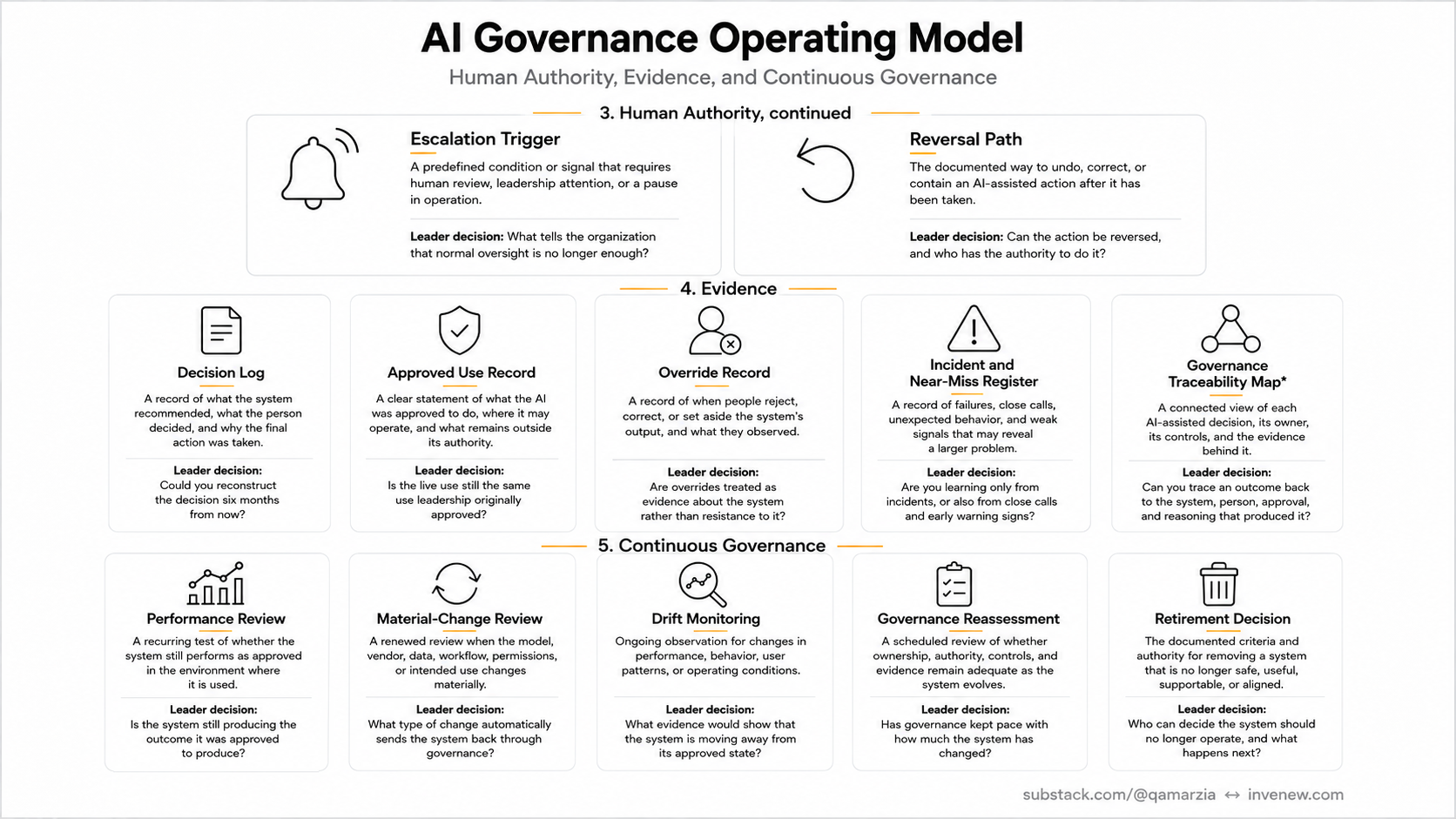
Set escalation triggers in advance. These may include falling confidence, a material complaint, unusual output patterns, a security event, repeated overrides, or consequences outside the approved scope.
Document the reversal path. Leaders should know whether an action can be undone, who contains downstream effects, and who authorizes correction.
For high-risk systems, Article 14 of the EU AI Act requires effective human oversight. It addresses over-reliance on system outputs, the ability to disregard or override an output, decisions not to use a system, and the ability to interrupt operation safely. NIST also treats appeal, override, monitoring, and incident response as governance processes. (EUR-Lex)
Leader decision: Who can pause, override, escalate, or reverse the system, and can they act immediately?
Layer 4: Evidence
Governance must be reconstructable.
A decision log records what the system recommended, what the person decided, and why. An approved use record defines what the system may do, where it may operate, and what remains outside its authority.
An override record turns disagreement into evidence. Repeated corrections may reveal a weak model, poor threshold, changing environment, misunderstood workflow, or training gap. Treating overrides as resistance destroys a valuable feedback channel.
Maintain an incident and near-miss register. Close calls and weak signals often reveal problems before serious failures. Connect these records through a traceability map linking the outcome to the system, owner, approved use, controls, human action, and supporting evidence.
The EU AI Act includes logging and record-keeping requirements for high-risk systems. ISO/IEC 42001 emphasizes traceability, transparency, reliability, and auditable management processes. NIST recommends documenting risk decisions, context, monitoring, incidents, and third-party dependencies. (EUR-Lex)
Leader decision: Could you reconstruct a consequential AI-assisted decision six months from now, including what happened, who acted, and why?
Layer 5: Continuous Governance
Approval is a start, not a finish.
Performance review asks whether the system still produces the approved outcome in the environment where it is used.
Material-change review sends it back through governance when the model, vendor, data, workflow, permissions, integration, users, or intended purpose changes significantly. A vendor release can be a governance event even when procurement does not change.
Drift monitoring looks for changes in performance, behavior, user patterns, data, and operating conditions. Governance reassessment asks whether ownership, authority, controls, and evidence still match the system’s reach and risk.
Every system also needs a retirement decision. Define who can remove it, what evidence triggers removal, how dependent workflows migrate, what records remain, and how access, data, and integrations close safely.
NIST states that AI risk management should be continuous across the lifecycle and includes decommissioning, change management, monitoring, incident response, and third-party review. ISO/IEC 42001 is built around maintaining and continually improving an AI management system. (NIST AI Resource Center)
Leader decision: What changes automatically trigger reassessment, and who can decide the system should no longer operate?
Start with one live system
Do not begin with a company-wide transformation.
Choose one AI-enabled workflow that affects a meaningful outcome. Name its owner. Map the decision it shapes. Define the authority line. Confirm what evidence exists. Set the next review date and the changes that would reopen approval.
That exercise will expose operating gaps faster than another general policy document.
Decision improved
How should leaders establish control over AI already operating inside their organization?
Takeaways
Inventory the AI already operating, including vendor features and unofficial tools.
Assign executive, system, decision, and domain ownership where needed.
Define who can pause, override, escalate, and reverse an AI-assisted action.
Preserve enough evidence to reconstruct decisions and learn from overrides and near misses.
Reassess after material changes, monitor for drift, and plan for retirement.
Scale controls to the system’s risk, autonomy, and context.
Which of the five layers is least developed in your organization today?
INVENEW exists to help tech builders, operators, founders, and leaders turn AI from experiments into working systems.
In partnership with AWS
🛡️ Modern security teams are navigating a rapidly changing threat landscape. As application architectures become more distributed and AI-driven, APIs and agentic patterns introduce new risks, from excessive data exposure to privilege escalation and tool poisoning. Traditional identity and trust boundaries are no longer enough to protect sensitive data and enforce governance.
In this webinar, experts from Amazon Web Services (AWS) and SANS Institute explore:
➝ Novel attack vectors introduced by APIs and agentic AI.
➝ The critical role of observability and token hygiene.
➝ Steps security leaders take to adapt governance and prepare for regulatory scrutiny.
See how to embed security early, align with compliance expectations, and discover AWS Partner solutions in AWS Marketplace.
Note: Third-party company and product names belong to their respective owners and are used for identification and illustrative reference only.