Watch how owning AI deployment expands your career

Missed the live roundtable? Watch three teams share how they made AI ownership their job, now on-demand.

The signal
AI applications are changing how builders think about databases. For many traditional apps, the database decision often started with a simple question: Should this be relational, document-based, or something else?
AI-native applications add more layers.
A useful AI app may need structured user data, document storage, semantic search, agent memory, event logs, workflow state, observability metrics, audit records, and analytics. These needs do not always belong in one database.
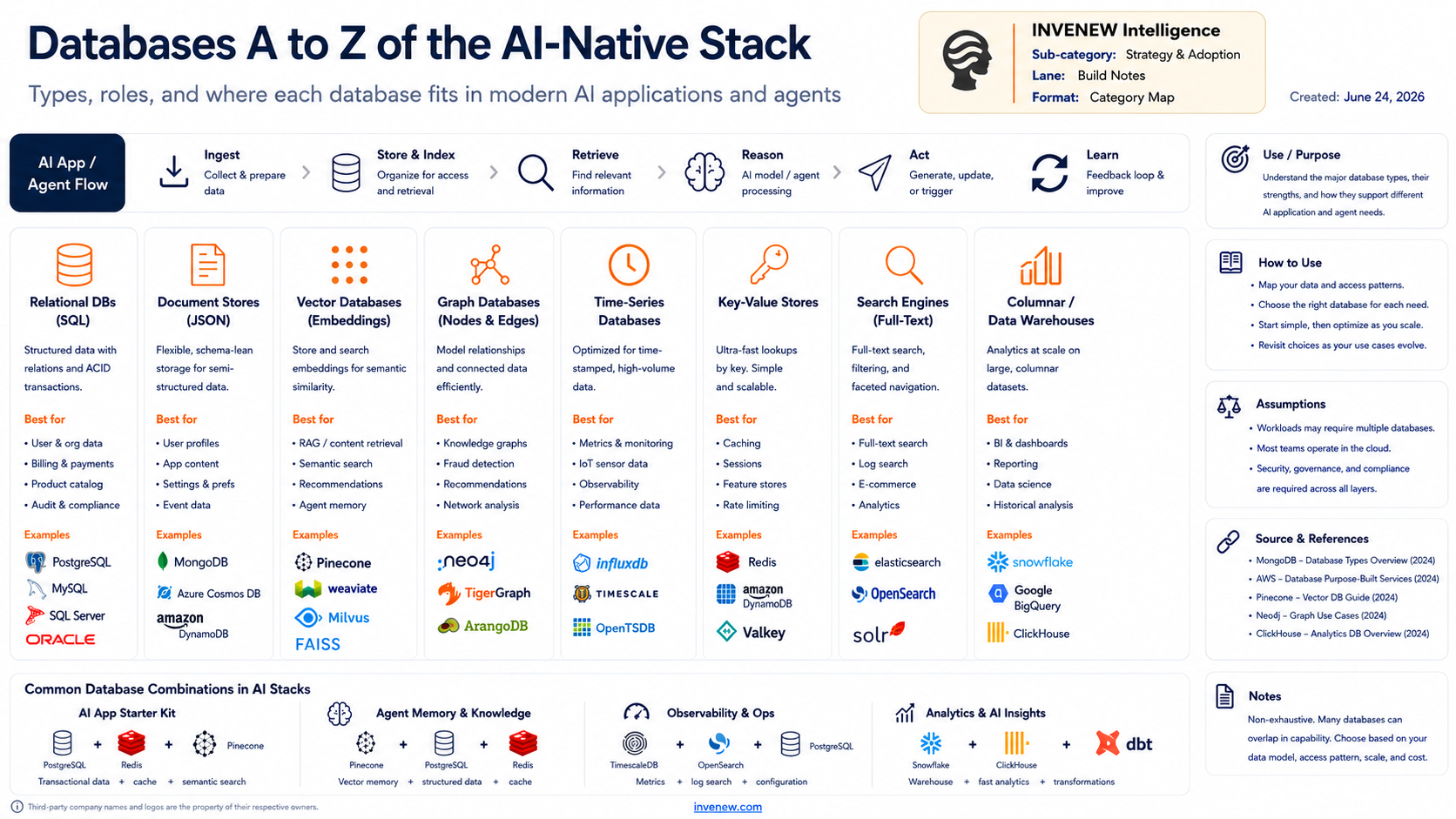
That is why database architecture is becoming part of the AI application stack, not just a backend detail. The attached map shows eight major database categories that commonly appear in modern AI applications:
Relational databases, document stores, vector databases, graph databases, time-series databases, key-value stores, search engines, and columnar data warehouses.
The practical question is not “Which database is best?”
The better question is:
What job does this database need to do inside the AI system?
Why it matters
AI builders often over-focus on models, prompts, and frameworks.
Those matter, but the database layer determines what the AI system can remember, retrieve, verify, monitor, and improve.
A model may generate the answer, but the database stack often decides:
what context the model can access
how fresh that context is
what user or workflow state is preserved
whether retrieval is fast enough
whether the system can be audited
whether agent actions can be traced
whether cost, latency, and quality can be measured
whether the product can scale beyond a demo
This is why database choices show up early in the AI app builder journey, especially at the Data & Architecture stage.
The builder/operator view
Relational databases
Relational databases remain the system of record for many AI applications.
They are strong for structured data, transactions, user accounts, billing, permissions, product catalogs, audit logs, and business records.
For AI apps, the relational database often answers the question:
What must be accurate, consistent, and queryable?
Document stores
Document stores are useful when the data is flexible or semi-structured.
They often fit user profiles, content objects, settings, app state, events, and records that may evolve quickly.
For builders, the benefit is flexibility. The tradeoff is discipline: flexible schemas still need clear data ownership and access rules.
Vector databases
Vector databases support semantic retrieval.
They are useful when the application needs to search by meaning rather than exact keywords. This is common in RAG systems, knowledge assistants, recommendations, agent memory, and content retrieval.
The key decision is whether semantic search is actually needed. Not every AI app needs a vector database.
Graph databases
Graph databases help model relationships.
They are useful for connected data: knowledge graphs, fraud detection, recommendation systems, network analysis, entity relationships, and agent context that depends on links between people, objects, systems, or events.
They become more valuable when the relationships matter as much as the records.
Time-series databases
Time-series databases are built for timestamped, high-volume data.
They fit metrics, monitoring, sensor data, observability, performance data, and system behaviour over time.
For AI systems, this matters because latency, usage, cost, errors, and quality signals all change over time.
Key-value stores
Key-value stores are useful for speed and simplicity.
They often support caching, sessions, feature stores, rate limiting, temporary state, queues, and fast lookups.
In AI apps, they can reduce latency and protect expensive model or database calls from being repeated unnecessarily.
Search engines
Search engines handle full-text search, filtering, ranking, faceted navigation, log search, and content discovery.
They are useful when users or operators need to search across large text-heavy datasets, logs, documents, product catalogs, or support content.
They may work alongside vector search rather than being replaced by it.
Columnar data warehouses
Columnar warehouses support analytics at scale.
They are useful for BI dashboards, reporting, historical analysis, product analytics, usage trends, and AI performance insights.
This layer helps teams move from “the app works” to “we understand how the app is being used and where it is creating value.”
What to watch
1. Database combinations will matter more than single choices
Many AI apps will use combinations: relational database for core data, vector database for semantic retrieval, cache for speed, search engine for logs, and warehouse for analytics.
The stack should be designed around access patterns, not vendor excitement.
2. Vector databases will become more disciplined
Vector search is powerful, but it is not magic memory.
Builders will need clearer decisions around chunking, metadata, freshness, permissions, retrieval quality, evaluation, and whether a vector database is needed at all.
3. Agent memory will force architecture decisions
Agentic workflows need memory, state, task history, tool outputs, approvals, and sometimes long-term context.
Those pieces may live in different stores. Treating “memory” as one vague bucket will create confusion.
4. Observability data will become part of the database strategy
AI apps need logs, traces, metrics, prompts, outputs, errors, latency, costs, and feedback.
That data needs somewhere to live, and it needs to be useful for debugging, evaluation, compliance, and improvement.
5. Governance will reach every database layer
Security, privacy, access control, auditability, and retention rules cannot sit outside the database architecture.
The more an AI system retrieves and acts, the more important it becomes to know what data it accessed, why it accessed it, and who approved the action.
Practical takeaway
Do not start database selection with a product list.
Start with the data jobs:
What data must be accurate and transactional?
What content needs flexible storage?
What needs semantic retrieval?
What relationships need to be modeled?
What needs fast lookup or caching?
What needs full-text search?
What needs time-based monitoring?
What needs analytics and reporting?
Then choose the smallest database combination that supports the application’s real workflow.
A simple starter pattern for many AI apps:
PostgreSQL for core app data
Redis for cache and sessions
Vector database for semantic retrieval only when needed
Search engine for logs or full-text discovery
Warehouse for analytics once usage grows
Start simple. Add layers when the workload proves they are necessary.
INVENEW Lens
For INVENEW Intelligence, the attached database map is a useful way to explain the hidden architecture behind AI applications.
Models get most of the attention, but databases shape what AI systems can know, retrieve, remember, monitor, and improve.
For INVENEW Labs, this can become a practical decision framework: map the AI application flow, identify the data jobs, then test the smallest database stack that supports the workflow.
The goal is not to use every database category.
The goal is to build AI systems where each database has a clear role.
Note: Third-party company and product names belong to their respective owners and are used for identification and illustrative reference only.
INVENEW exists to help tech builders, operators, founders, and leaders turn AI from experiments into working systems.