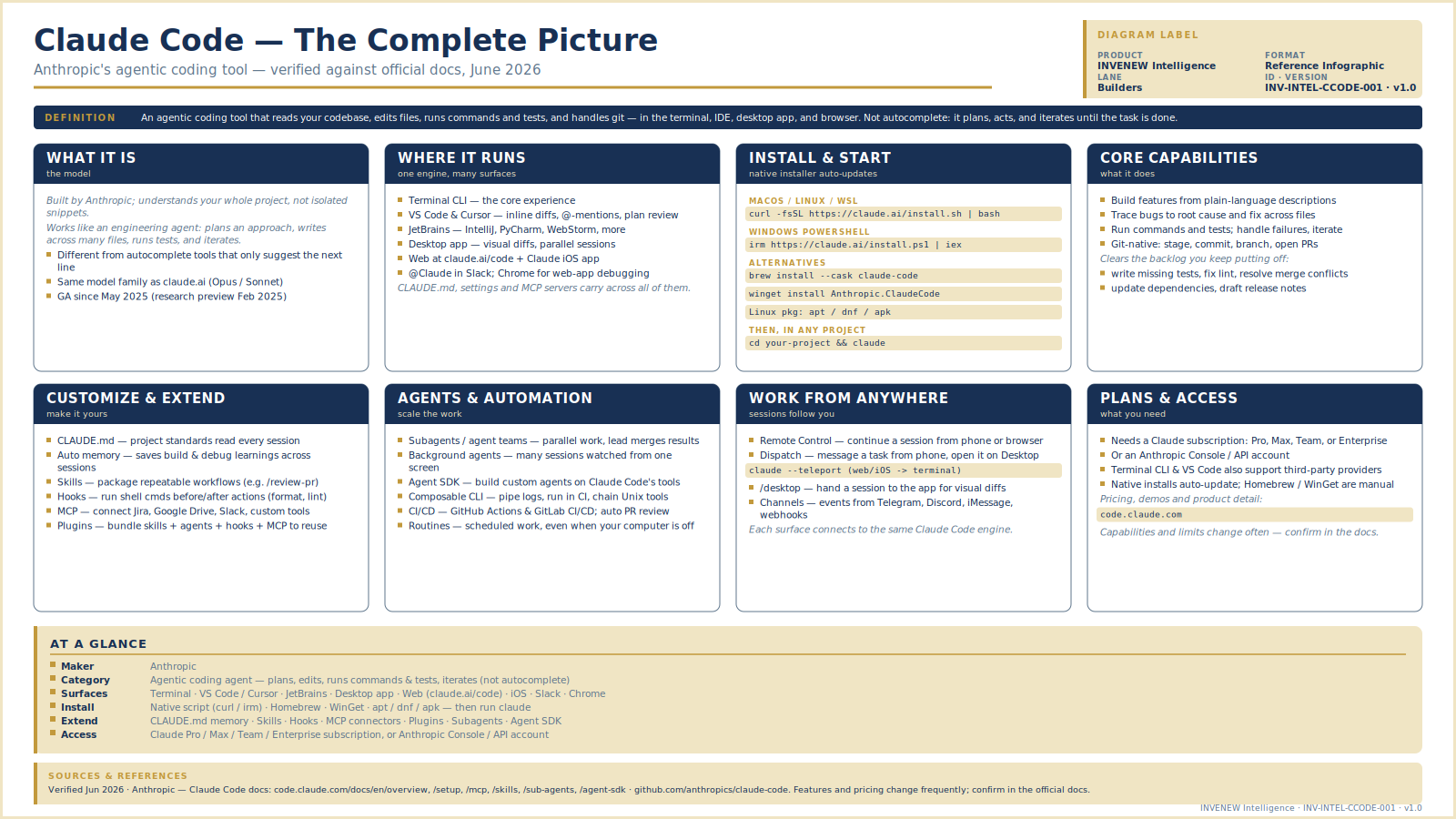

AI coding agents are usually discussed as code-generation tools.
That framing is too small.
Inside INVENEW Labs, I have been using Claude Code while building and refining the real operating stack behind INVENEW: GitHub, Vercel, Sanity, AWS decisions, deployment checks, QA workflows, content pipelines, and documentation.
Not in a demo repo.
In the actual mess of building, shipping, fixing, and operating.
That is where Claude Code becomes interesting.
The signal
Claude Code is not only useful when it writes code.
It becomes more useful when it can move through the engineering loop:
read the codebase
understand project structure
edit files
run commands
inspect failures
suggest fixes
tighten docs
support QA
and connect changes back to the system being operated
That makes it feel less like a code autocomplete tool and more like an engineering collaborator with boundaries.
The boundary matters.
Claude Code can accelerate the work.
It cannot own the judgment.
Why it matters
The hard part of AI-assisted engineering is not getting an agent to generate code.
That part is becoming easier.
The harder part is making sure the agent’s work fits:
the architecture
the repo structure
the deployment path
the content model
the QA process
the operational workflow
and the business context
This is where many AI-assisted builds start to drift.
The agent can make a technically plausible change that still violates the system.
It can fix a local problem while creating a downstream issue.
It can produce working code that does not match the naming rules, publishing workflow, source-of-truth docs, or deployment discipline.
So the real question is not:
Can AI write code?
The better question is:
Can AI help operate the system around the code?
What I am testing in INVENEW Labs
I am using Claude Code as part of a broader founder/operator workflow that includes:
GitHub for version control and pipeline flow
Vercel for deployment and preview checks
Sanity for structured content operations
AWS and related infrastructure decisions
ChatGPT / Custom GPTs for planning, drafting, review, and workflow support
Codex-style review loops for debugging, critique, and second-pass analysis
Source-of-truth docs for decisions, naming, taxonomy, and operating rules
The goal is not to let an agent “run the company.”
The goal is to test whether agents can support the operating layer around technical work.
That means:
faster iteration
cleaner handoffs
better documentation
more consistent QA
fewer missed deployment steps
and more reusable workflows
The operating lesson
Claude Code works best when the system around it is clear.
It needs:
clear repo structure
good naming conventions
source-of-truth docs
approval gates
deployment discipline
human QA
and explicit instructions about what not to change
That last part is underrated.
AI agents need constraints as much as they need capabilities.
Without constraints, they become fast chaos.
With constraints, they become leverage.
The takeaway
AI coding agents are not replacing the operating stack.
They are becoming part of it.
They sit somewhere between:
IDE
terminal
junior engineer
reviewer
documentation assistant
QA helper
and workflow operator
That is powerful.
But it is not autonomous in the way many people imagine.
The value comes from combining agent capability with human judgment and a well-designed operating system.
For founders, builders, and technical operators, the shift is important:
The future is not just AI that writes code.
It is AI that helps manage the loop around code — from design to deployment to QA to operations.
That is the layer I am watching closely.
Operator takeaway
Treat Claude Code as part of your engineering operating system, not just your coding toolkit.
Start small:
give it a clear repo
define what it can touch
document your naming and workflow rules
require review before deployment
capture what worked and what broke
turn repeatable patterns into SOPs
The agent becomes more useful when the operating system around it becomes clearer.
What to watch
The next phase of AI coding tools will not be judged only by code quality.
It will be judged by how well they support:
multi-file changes
repo understanding
tests and QA
deployment workflows
documentation
approval gates
tool integrations
and operational reliability
That is where the real race is moving.
Not just code generation.
Operational leverage.
INVENEW exists to help tech builders, operators, founders, and leaders turn AI from experiments into working systems.

Sponsored: In partnership with AWS