

In This Issue
Why “managed service” and “dedicated engine” are separate decisions
When a database extension is the strongest default
What a dedicated vector engine must earn
Which workload characteristics should drive the benchmark
How to test the choice using your own retrieval traffic
The signal
Vector search is no longer a capability available only from specialized vector databases.
PostgreSQL extensions, cloud databases, document databases, search platforms, data warehouses, and managed AI services can now store embeddings and run similarity searches. Dedicated vector engines have also expanded beyond nearest-neighbour search into filtering, hybrid retrieval, multi-tenancy, replication, and managed cloud delivery.
That creates a crowded decision.
A team building retrieval into an application may encounter three recommendations:
Add vector support to the database it already runs.
Use a fully managed vector service.
Deploy a dedicated vector engine.
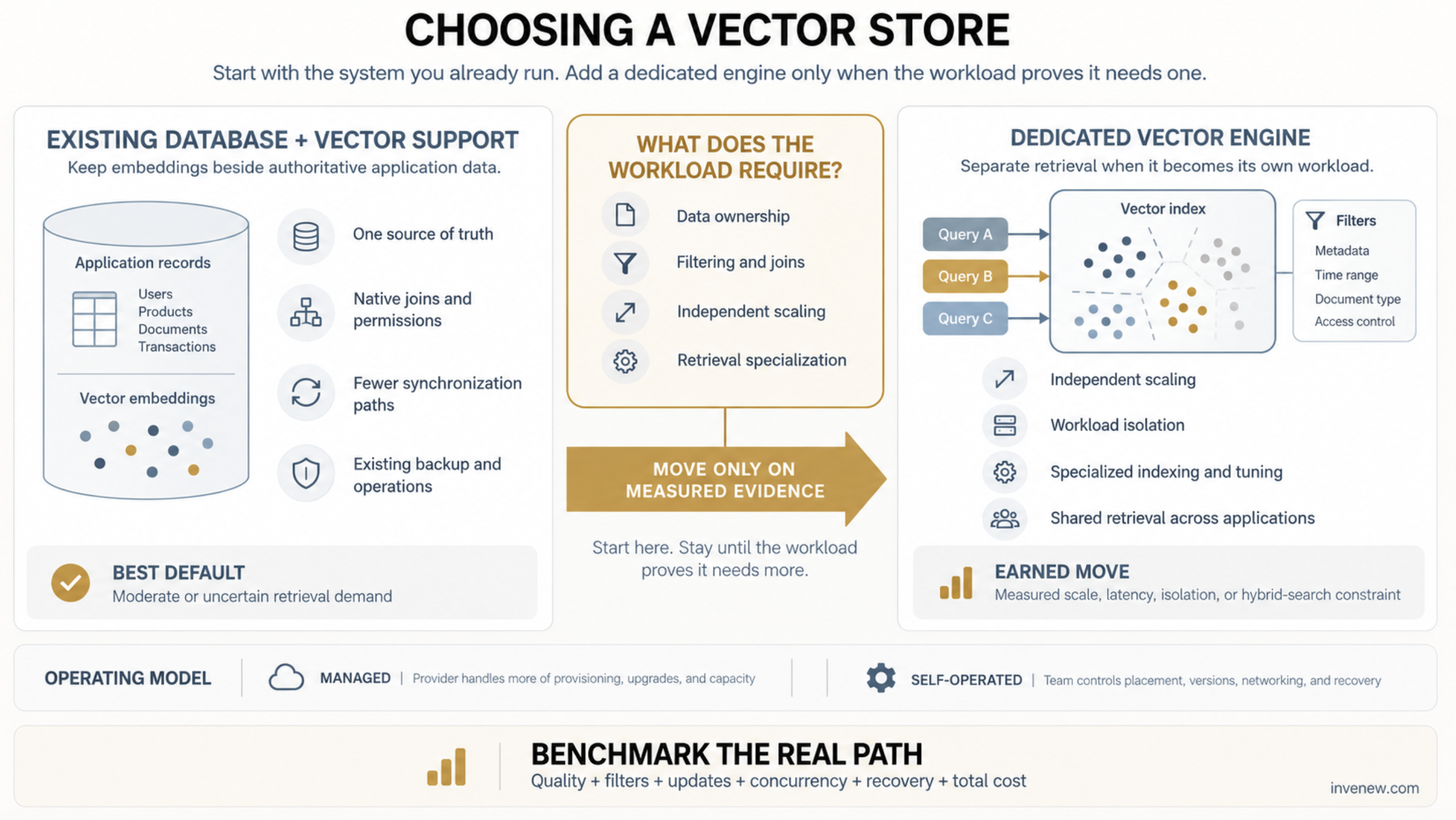
These choices sound like three competing categories. They are not.
“Managed” describes who operates the system. “Extension” and “dedicated engine” describe where vector retrieval sits in the architecture. A database extension can be delivered through a managed PostgreSQL service. A dedicated engine can be consumed as a managed cloud service or operated by your own team.
The decision therefore has two axes:
Should vector retrieval live with existing application data or in a separate system?
If it becomes a separate system, should your team operate it or buy it as a managed service?
Separating those questions produces a clearer answer.
What is being chosen
A vector store holds embeddings and retrieves records whose vectors are close to a query vector. In a retrieval workflow, that search is usually combined with metadata filters, permissions, recency rules, keyword signals, or reranking.
The storage choice affects more than search speed. It determines:
Where authoritative content lives
How changes reach the vector index
Whether filters and joins remain consistent
How tenant isolation is enforced
What must be backed up and restored
Which system must scale with retrieval traffic
How many operational surfaces the team owns
The simplest implementation is often a vector column and index inside an existing database.
For example, pgvector adds exact and approximate nearest-neighbour search to PostgreSQL, including HNSW and IVFFlat indexes. The application can keep embeddings beside relational records and combine vector similarity with normal SQL conditions.
At the other end, a dedicated system such as Pinecone, Qdrant, Weaviate, or Milvus treats vector retrieval as its primary workload. These products offer different combinations of indexing, filtering, hybrid search, partitioning, replication, tenant isolation, and operational control.
The category does not determine the winner. The workload does.
The architecture benchmark
This comparison is a decision benchmark, not a claim that every product in a category performs the same way.
Decision factor | Existing database with vector support | Dedicated vector engine |
|---|---|---|
Data ownership | Strong when embeddings belong to records already stored in the database | Strong when retrieval has its own corpus, lifecycle, or ingestion system |
Consistency | Fewer synchronization paths between business data, metadata, and vectors | Requires a deliberate change-data or ingestion path from authoritative sources |
Filtering and joins | Strong when queries depend on relational filters, permissions, or transactions | Strong when filters are designed into the vector index and retrieval model |
Operational load | Reuses current backup, security, monitoring, and access practices | Adds another service unless consumed as a managed offering |
Independent scaling | Vector queries share resources and scaling decisions with the primary database | Retrieval capacity can scale separately from transactional workloads |
Specialized retrieval | Often sufficient for semantic search and modest hybrid workloads | Better fit when retrieval needs advanced tuning, partitioning, hybrid ranking, or high concurrency |
Failure surface | Fewer systems, but search load can affect the application database | Better workload isolation, but more synchronization and recovery paths |
Cost shape | Can be efficient when spare database capacity and existing skills are available | Can be efficient at retrieval-heavy scale, but introduces separate service and transfer costs |
Portability and control | High when based on familiar database standards and self-operated infrastructure | Varies widely by engine, hosting model, APIs, and export path |
The comparison points to a useful default.
Use the system you already operate when it meets the retrieval requirement without threatening its primary workload.
A separate engine should earn its place by solving a measured constraint.
When an extension is enough
An existing database with vector support is usually the stronger starting point when:
The vectors describe rows already stored there.
Retrieval depends heavily on relational filters or permissions.
The corpus changes through the same application transactions.
Query volume is moderate or uncertain.
The team already knows how to secure, monitor, back up, and restore the database.
The application is still validating whether retrieval creates useful results.
This approach reduces architecture before it reduces search latency.
There is one authoritative record, one main permission model, and fewer synchronization jobs. A deleted document, changed access rule, or updated status can be reflected without coordinating two independent systems.
It also keeps the first benchmark honest. The team can evaluate retrieval quality, filtering, index behaviour, latency, and cost before committing to another platform.
Database-integrated vector search is no longer limited to basic prototypes. Managed PostgreSQL services and larger distributed databases increasingly expose vector indexes alongside their existing data models. Google, for example, documents vector capabilities across AlloyDB, Spanner, and BigQuery as well as its dedicated Vector Search service. This illustrates the broader shift: vector retrieval has become a database capability as well as a product category. Google Cloud
The limitation appears when the vector workload starts dictating the design of a database whose first responsibility is transactional or analytical work.
When a dedicated engine earns its place
A dedicated vector engine becomes easier to justify when retrieval needs to scale, fail, or evolve independently.
The strongest signals are operational:
Vector queries create unacceptable contention with transactional traffic.
The index is much larger than the application’s primary dataset.
Ingestion and query loads have different scaling patterns.
The workload needs many isolated tenants or collections.
Filtering behaviour is central to performance.
Hybrid keyword and semantic retrieval is a first-class requirement.
The team needs specialized index controls or hardware placement.
Several applications need one shared retrieval service.
Search availability has a different service objective from the source database.
These conditions do not automatically require a dedicated engine. They identify what should be benchmarked.
Vector count alone is a weak decision rule. Ten million small vectors queried occasionally with simple filters may be less demanding than a smaller index serving high concurrency, frequent updates, strict tenant boundaries, and complex filters.
The shape of the traffic matters as much as the size of the corpus.
Managed or self-operated
Once a separate engine is justified, the next decision is who should operate it.
A managed service buys back work. Provisioning, upgrades, replication, capacity management, and parts of monitoring may move to the provider. It can be the right choice when the team needs retrieval capability but does not want vector infrastructure to become a core operating responsibility.
Self-operation provides greater control over placement, versions, networking, data handling, and cost engineering. It also makes the team responsible for upgrades, recovery, scaling, observability, and failure response.
Choose self-operation when that control changes a real requirement. Data residency, disconnected environments, existing cluster capacity, specialized performance tuning, or a strong internal platform practice may qualify.
Avoid choosing it only because the software is open source. A licence removes a purchase barrier. It does not remove the operational system around the engine.
What to know before committing
A vector-store benchmark should use the application’s real retrieval path.
Do not test only isolated nearest-neighbour latency against a clean corpus. Include:
The embedding model and vector dimensions you will use
Representative document sizes and metadata
The actual mix of inserts, updates, deletes, and queries
Permission and tenant filters
Keyword or hybrid retrieval where required
The target recall or retrieval-quality measure
Concurrency at normal and peak load
Index-build and recovery time
Backup, restore, and data-export procedures
Total infrastructure and operating cost
Measure end-to-end retrieval, not only database response time.
A faster search can still produce a slower answer if it adds network distance, synchronization delay, extra reranking, or more application-side filtering. It can also produce a worse answer if tuning improves latency by sacrificing useful recall.
Run failure tests as part of the benchmark. Stop ingestion. Delay an update. Remove a document at its source. Change a user’s permissions. Restore the index. Confirm that the system can identify stale results and reconstruct the retrieval layer without treating it as the authoritative content store.
Worth reading
Google Cloud’s RAG infrastructure reference architecture is useful because it shows a managed dedicated vector service and then identifies database-integrated alternatives, making the architecture choice visible rather than presenting one product as universal.
Takeaways
Start with the smallest architecture that can satisfy the retrieval requirement.
Identify which system owns the underlying documents, records, permissions, and deletion state.
Decide whether embeddings can live beside that authoritative data without creating unacceptable load or coupling.
Define the retrieval-quality target before comparing infrastructure.
Benchmark real filters, updates, concurrency, failures, and recovery. Do not benchmark nearest-neighbour latency alone.
Keep the existing database when it meets the target within an acceptable operating margin.
Add a dedicated engine when independent scaling, isolation, retrieval specialization, or shared-service requirements justify another system.
Choose managed delivery when operating the engine creates little differentiated value.
Choose self-operation only when control over infrastructure, locality, security, or cost changes the outcome.
The practical default is an extension to what you already run.
The trigger to move is measured evidence that retrieval has become a distinct workload with distinct operating requirements.
What constraint would force you to move vector retrieval out of the database you already operate?
If this helped you, leave a comment or your reaction. I’d like to hear where you landed.
INVENEW exists to help tech builders, operators, founders, and leaders turn AI from experiments into working systems.
In partnership with AtScale
Everyone in data and AI is selling "context." Almost no one means the same thing by it. Metadata catalogs call themselves context platforms. So do knowledge graphs, warehouse-native semantics, and workflow engines. Each solves a real problem. Most of them don't solve the same one.
Note: Third-party company and product names belong to their respective owners and are used for identification and illustrative reference only.