

In This Issue
The agent layer and the model layer are different decisions; most coverage conflates them.
Qwen Code is the closest Chinese analogue to Claude Code; GLM is the value leader.
DoorDash now routes lower-level coding work to Kimi and reserves frontier models for the hardest tasks.
The privacy question is deployment path, not country of origin.
Congress has turned model provenance into a governance field.
The signal
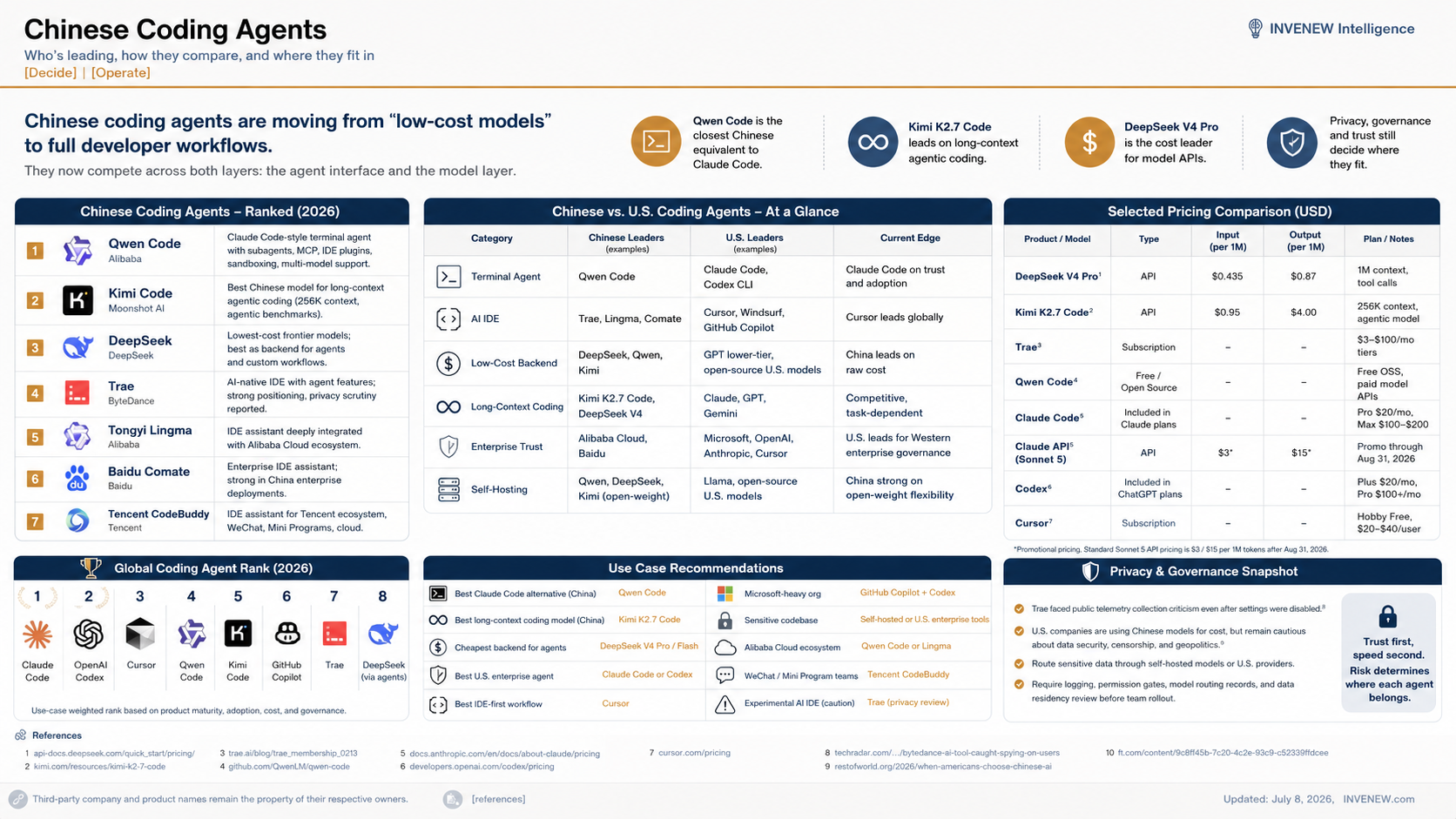
Chinese AI companies are no longer competing only at the model layer. They now ship the full agent layer: Qwen Code explicitly targets feature parity with Claude Code, Moonshot ships Kimi Code, Z.ai sells a GLM Coding Plan, and all of them run as backends inside Claude Code through Anthropic-compatible endpoints. The harness standard is American; the price war is Chinese. Meanwhile the demand side moved: the share of tokens US companies spent on Chinese AI models via OpenRouter has sat above 30 percent every week since February 8, peaking near 46 percent, against a 12-month average of 11 percent.
What it is: two layers, two decisions
A model can be excellent at coding and still not be a strong agent product. The agent layer owns permissions, file edits, shell commands, context management, and review flow; the model layer owns capability, context length, and price.
Layer | Chinese examples | Decision it drives |
|---|---|---|
Full coding agents | Qwen Code, Kimi Code, Tencent CodeBuddy, Alibaba Lingma | Permissions, audit, workflow fit |
Model backends | Qwen3-Coder, Kimi K2.6/K2.7, DeepSeek V4, GLM-5.x | Capability, context, price |
The distinction matters commercially too. When Cursor's Composer 2 was traced to Moonshot's Kimi line and Windsurf confirmed SWE-1.5 runs on Z.ai's model, the products were American, the harnesses were American, and the intelligence underneath was Chinese. Buyers who evaluated those tools as US products inherited a Chinese model dependency without ever making that decision explicitly. That is the failure mode this issue is designed to prevent.
Ranking the Chinese field
Among agents, Qwen Code leads: a free, open-source terminal coding agent forked from Gemini CLI with Qwen3-Coder as the default model, Apache-2.0 licensed, with interactive and headless modes, support for OpenAI-compatible, Anthropic, Gemini, and local endpoints, plus VS Code, Zed, and JetBrains integrations. The honest caveat: its agentic loop is less mature than Claude Code, and autonomous multi-file editing requires more manual intervention.
Among model backends, GLM-5.2 leads the Chinese field on independent coding and agent leaderboards, DeepSeek V4 wins on price, Qwen is the most-adopted open base, and Kimi K2.6 is strongest for long agent runs. Behind these four sit the enterprise-ecosystem tools, Tencent CodeBuddy, Alibaba Lingma, and Huawei CodeArts, which matter mainly if your organization already runs on those clouds.
Global rank and the gap that remains
The top of the standardized harnesses is still American. On Terminal-Bench 2.1, Codex CLI on GPT-5.5 leads at 83.4% with Claude Code on Fable 5 at 83.1%; on SWE-bench Verified, Fable 5 leads at 95.0% and Opus 4.8 at 88.6%. The Chinese flagships sit a tier below on these harnesses but compress the gap monthly, and GLM-5.1 reaches roughly 94 percent of Opus 4.6 on coding evals at a fraction of the monthly price. Read those two facts together and the strategy writes itself: the quality ceiling is American, the cost floor is Chinese, and the spread between them is where routing decisions live.
Pricing reality
Qwen Code is free with 1,000 requests per day via Qwen OAuth; GLM coding plans have been marketed from $3 per month, against $20 entry points for Claude Code, Cursor, and Codex. Two operating cautions. First, one prompt in a coding tool typically triggers 5 to 30 model calls, and quotas reset on rolling 5-hour windows, so sticker prices understate variance. Second, these plans reprice and restock erratically, and some tiers sell out or get discontinued with little notice; verify the tier the week you buy.
Versus Claude Code specifically
Qwen Code is the cleanest structural analogue: terminal-native, open-source, MCP-capable, explicitly built to Claude Code's shape. On quality, none of the Chinese stacks beats Claude Code today; the accurate framing is value substitute, not replacement. The pattern serious teams run is routing: DoorDash cofounder Andy Fang said the company delegates lower-level work to Kimi K2.6 and reserves Anthropic's Fable for only the hardest work. That split, frontier for judgment, discount for volume, is the operating model this issue recommends.
Who is actually using them
The public evidence is thinner than the conversation suggests. Grade the claims:
Company | Verified use | Coding-agent use? |
|---|---|---|
DoorDash | Lower-level work on a Moonshot model, per its cofounder | Likely, stated by cofounder |
Cursor (Anysphere) | Composer 2 traced to Moonshot's Kimi line | Yes, model backend |
Windsurf | SWE-1.5 confirmed running on Z.ai's model | Yes, model backend |
Airbnb | Relies heavily on Qwen among 13 models | No; customer service, not coding |
Lindy | Moved from Anthropic tools to DeepSeek V4 | Partial |
The distinction matters: most of this is model adoption inside American products, not adoption of Chinese agent products. The House probe into Airbnb and Anysphere frames the issue as supply-chain and data-control risk, and Airbnb's CEO later clarified the company was not sending data to the model developers.
Privacy: the question is deployment path
Path | Posture |
|---|---|
Consumer web apps | Highest risk; prompts processed in China, subject to Chinese data law |
Direct API to Chinese provider | Requires legal and data-residency review |
US/EU-hosted proxy | Better; verify prompts are not routed upstream |
Self-hosted open weights | Removes residency risk, not political risk |
US vendor with zero data retention | Strongest path for sensitive repos |
The eight-question audit before committing
Which model sees the repository, and is that documented anywhere a regulator could read?
Where does the code physically go: local, US cloud, or a Chinese endpoint behind a proxy?
Can the agent run shell commands, and with whose permissions?
Can it touch production credentials, or are secrets excluded from its environment?
Are prompts retained by the provider, and under what jurisdiction?
Is the model self-hosted, proxied, or vendor-hosted, and who verified that claim?
Can you audit every file edit and command the agent executed?
Can developers override, review, and roll back anything it did?
If any answer is unknown, that is the finding. The coding-agent decision is now an architecture decision. Cost matters; control matters more.
Recommendations by use case
Frontier quality and hard refactors: Claude Code. Terminal end-to-end: Codex CLI. Closest Chinese Claude Code analogue: Qwen Code with Qwen3-Coder. Long-context agent runs on a budget: Kimi. Cheapest serious backend for non-sensitive work: DeepSeek V4. Budget experimentation: GLM coding plan. Regulated work: US-hosted with zero data retention, and document the provenance of anything already shipped.
Worth reading
Rest of World on why Chinese model popularity in the US is not converting to revenue, the political scrutiny notwithstanding: https://restofworld.org/2026/when-americans-choose-chinese-ai/

Source: rest of world
Takeaways
Decide the agent layer and the model layer separately; the agent owns your permissions and audit trail.
Route by task: frontier for judgment, discount backends for volume, per the DoorDash pattern.
Treat model provenance as required stack metadata; regulators now ask, and buyers of US tools have inherited Chinese dependencies without knowing.
Judge privacy by deployment path, not flag.
Benchmark on your own repo; leaderboard gaps rarely survive contact with your codebase.
Reply prompt: If you route work across two coding stacks today, what rule decides which tasks go to the cheaper one?

Note: Third-party company and product names belong to their respective owners and are used for identification and illustrative reference only.
INVENEW exists to help tech builders, operators, founders, and leaders turn AI from experiments into working systems.
In partnership with
Why did one company's AI work, and another's didn't?

One had a dedicated owner. Resolution rate: 48.9%. One didn't: 0.38%. See the full breakdown.