
The signal
AI-native founders are not just building software faster. They are building across a wider set of decisions earlier than traditional software founders often had to.
A founder now has to think about the user problem, workflow design, data architecture, AI model behaviour, retrieval, agent actions, guardrails, evaluation, deployment, observability, cost, and operating loops — often before the product has meaningful traction.
That can feel like too much.
The useful way to simplify it is to treat AI-native product building as a journey.
Not a rigid waterfall. Not a one-time checklist. A practical sequence of decisions.
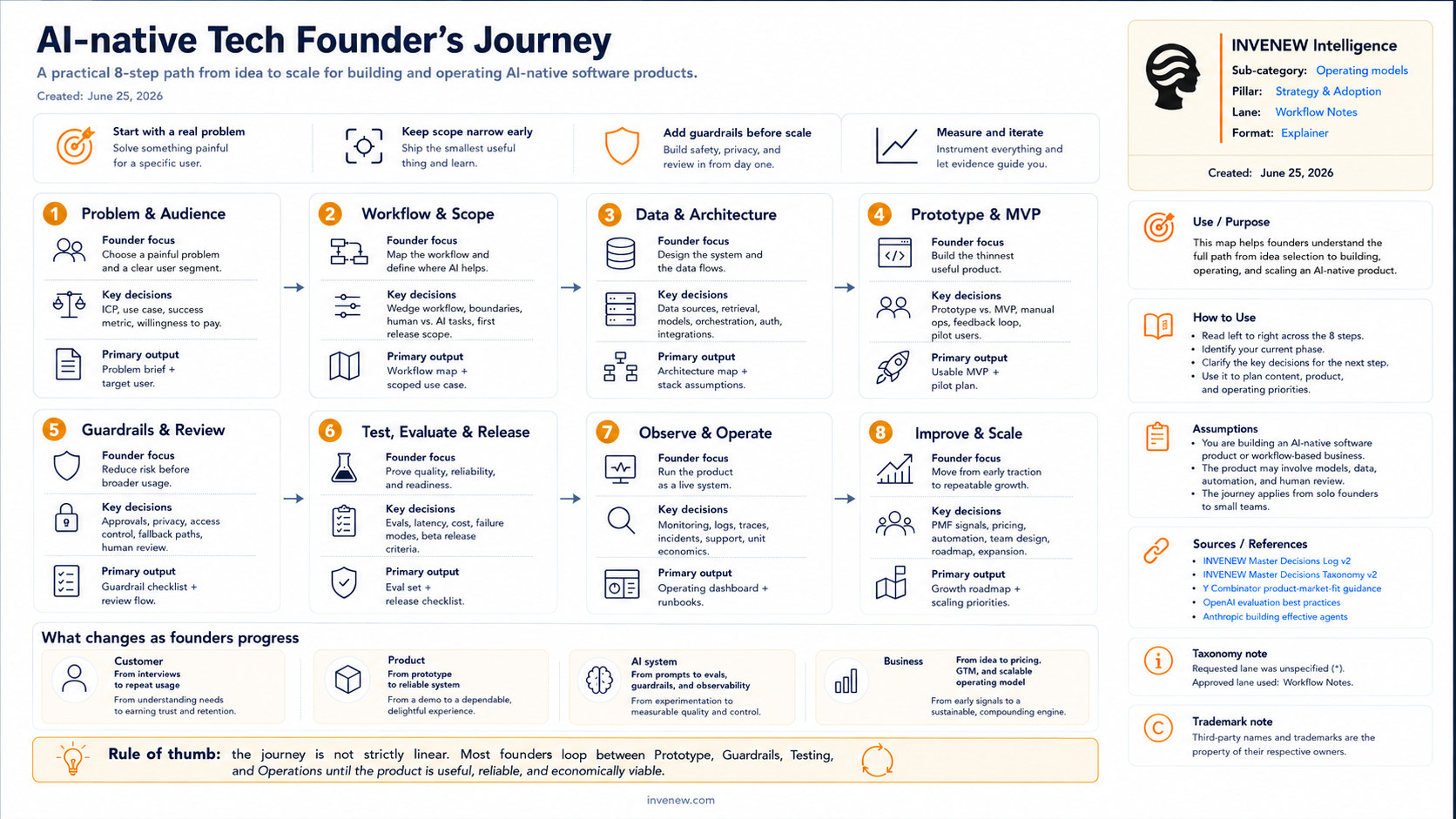
The attached map breaks that journey into eight stages:
Problem & Audience
Workflow & Scope
Data & Architecture
Prototype & MVP
Guardrails & Review
Test, Evaluate & Release
Observe & Operate
Improve & Scale
Each stage asks a different founder question. Each stage produces a different output. And each stage helps prevent a common mistake: building too much before the product, workflow, and operating model are clear.
Why it matters
AI-native products can look impressive very early.
A prototype can produce text, analyze data, call a tool, search documents, generate code, or simulate a workflow in a few hours. That speed is useful, but it can also hide weak product thinking.
The product may still have:
an unclear user
a vague workflow
messy data assumptions
no approval model
no evaluation criteria
no release discipline
no observability
no cost model
no path from demo to repeatable use
The founder’s job is not to bolt all of this on later.
The founder’s job is to move through the journey with enough discipline to avoid accidental architecture, accidental risk, and accidental complexity.
The map helps because it separates the founder’s work into phases. You do not need to solve everything on day one. But you do need to know what kind of decision you are making.
The builder/operator view
1. Problem & Audience
The journey starts with a real problem for a specific user.
This sounds obvious, but AI makes it easier to skip. A founder can generate interfaces, workflows, agents, and demos before proving that anyone has a painful enough problem.
The founder focus here is simple: Choose a painful problem and a clear user segment.
The key decisions are the ideal customer profile, use case, success metric, and willingness to pay.
The output should be a problem brief and target user definition.
Without this stage, the product becomes a feature playground.
2. Workflow & Scope
Once the problem is clear, the next question is workflow.
What does the user do today? What steps are painful? Where does AI help? Where should a human stay in control? What should be built now, and what should wait?
This is where founders should keep scope narrow.
The key decisions are workflow boundaries, human-versus-AI tasks, first release scope, and what not to build.
The output should be a workflow map and scoped use case.
This stage is especially important for AI-native products because many failures come from automating too much too early.
3. Data & Architecture
After the workflow is mapped, the founder needs to understand the system.
What data enters the product? Where does it live? What does the AI layer need? What needs storage, retrieval, orchestration, authentication, integrations, and monitoring?
The key decisions are data sources, retrieval, model choices, orchestration, auth, and integrations.
The output should be an architecture map and stack assumptions.
This is where a founder moves from “cool AI feature” to “working software system.”
4. Prototype & MVP
The prototype should be the thinnest useful product.
Not the full vision. Not the dream platform. Not the complete operating system.
The founder focus is to build the smallest version that proves the workflow creates value.
The key decisions are prototype versus MVP, manual operations versus automation, feedback loops, and pilot users.
The output should be a usable MVP and pilot plan.
This is where founders should resist the urge to polish too early.
5. Guardrails & Review
AI-native products need guardrails earlier than many founders expect.
That does not mean heavy governance. It means basic operating discipline.
Where does a human approve? What data is sensitive? What actions should the AI never take? What happens when the model is uncertain? What is logged? What is reviewed?
The key decisions are approvals, privacy, access control, fallback paths, and human review.
The output should be a guardrail checklist and review flow.
This stage helps prevent the product from becoming risky as usage grows.
6. Test, Evaluate & Release
AI products need evaluation beyond traditional QA.
A normal app test may check whether a button works. An AI-native product also needs to test answer quality, retrieval quality, hallucination risk, latency, cost, failure modes, and whether outputs meet user expectations.
The founder focus is to prove quality, reliability, and release readiness.
The key decisions are evals, latency, cost, failure modes, and beta release criteria.
The output should be an evaluation set and release checklist.
This stage is where founders turn “it worked once” into “it works often enough to release.”
7. Observe & Operate
Once the product is live, it becomes an operating system.
The founder needs to monitor logs, traces, incidents, support issues, user feedback, costs, latency, and reliability.
The key decisions are monitoring, support, runbooks, unit economics, and improvement loops.
The output should be an operating dashboard and runbooks.
This is where many AI-native products either mature or collapse under hidden complexity.
8. Improve & Scale
Scale should come after evidence.
The founder focus is to move from early traction to repeatable growth.
The key decisions are product-market fit signals, pricing, automation, team design, roadmap, and expansion.
The output should be a growth roadmap and scaling priorities.
This stage is not just about more users. It is about making the product more reliable, repeatable, and economically viable.
What changes as founders progress
The journey changes four things.
Customer understanding moves from interviews to repeat usage.
Early signals are useful, but repeat usage shows whether the product is becoming part of real work.
The product moves from prototype to reliable system.
A demo proves possibility. A product proves repeatability.
The AI system moves from prompts to evals, guardrails, and observability.
The more useful the product becomes, the more measurable and controlled the AI layer needs to be.
The business moves from idea to operating model.
Pricing, support, delivery, cost, automation, and retention eventually matter as much as the original feature.
The journey is not strictly linear. Most founders loop between prototype, guardrails, testing, and operations until the product becomes useful, reliable, and economically viable.
What to watch
1. Scope discipline
AI makes it easy to expand the product too quickly. Watch whether the first release solves one painful workflow before adding more capabilities.
2. Data readiness
Many AI-native ideas fail because the required data is unavailable, messy, sensitive, stale, or difficult to retrieve.
3. Human review points
The right approval gates should appear before scale, not after an incident.
4. Evaluation quality
A founder should know what “good output” means before claiming the system works.
5. Operating cost
LLM calls, retrieval, infrastructure, observability, support, and manual review all shape the business model.
Practical takeaway
Use the map as a founder operating checklist.
Do not ask, “What AI product should I build?”
Ask:
Where am I in the journey right now?
Then focus on the next decision.
If you are still unclear on the user, do not obsess over architecture.
If the workflow is vague, do not overbuild the MVP.
If the MVP works once, do not skip evaluation.
If users are active, do not ignore observability and cost.
AI-native products move fast, but the founder still needs sequence.
INVENEW Lens
This journey map sits at the center of INVENEW’s practical work.
INVENEW Intelligence explains the decisions founders and builders need to understand. INVENEW Labs tests the tools, workflows, architectures, and operating models behind those decisions. The Briefing turns those lessons into short, useful guidance for people building real systems.
The deeper point is simple:
AI-native product building is not just about models or tools.
It is about moving from problem to workflow, from workflow to architecture, from architecture to usable product, and from usable product to a system that can be trusted, operated, and improved.
That is the founder journey worth mapping.
INVENEW exists to help tech builders, operators, founders, and leaders turn AI from experiments into working systems.
In partnership with👇
200+ Proven Ways to Make Money With AI in 2026
The next wave of millionaires will be people who figured out how to make AI work for them.
The window to get ahead is still open. But not for long.
Here are 200+ proven ways to make money with AI in 2026.
Sign up for Superhuman AI, the free daily newsletter read by 1M+ professionals, and get instant access to all 200+ ways to profit from AI this year.