
The signal
AI app deployment used to feel like a simple hosting question.
Pick a frontend platform. Push code. Connect a domain. Done.
That worked when most apps were static websites, dashboards, forms, or simple CRUD applications. It still works for many early AI app prototypes. But once the application starts using model APIs, background jobs, user data, agents, queues, file processing, observability, and human review, deployment becomes an architecture decision.
The platform you choose starts shaping what kind of AI application you can safely build.
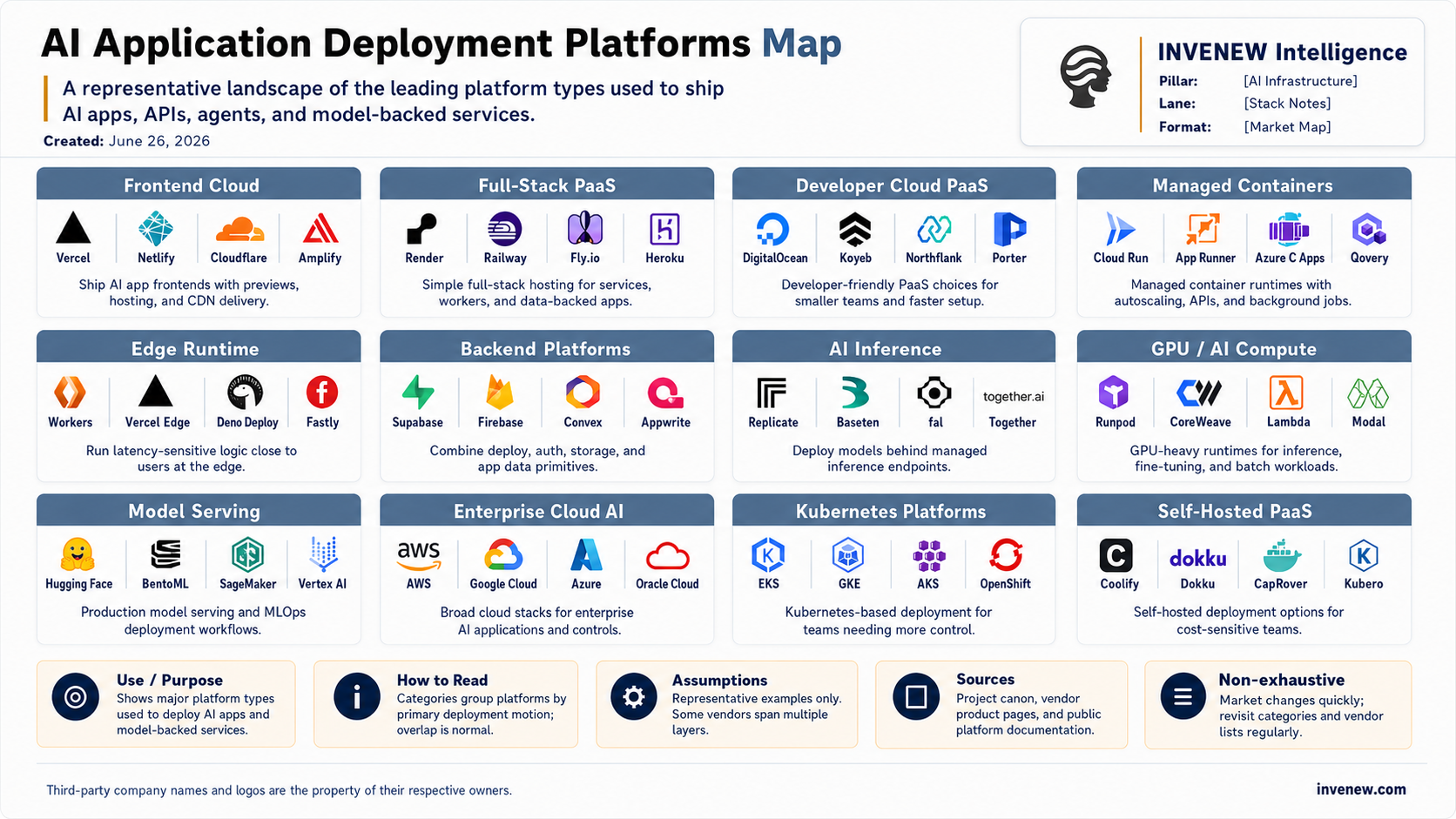
A frontend-first AI app may fit well on Vercel, Netlify, Cloudflare Pages, or Amplify. A fuller product with APIs, workers, databases, jobs, and internal services may push toward Render, Railway, Fly.io, Heroku, DigitalOcean, Northflank, Porter, or a hyperscaler path. Model-heavy workloads may need Replicate, Baseten, Hugging Face, SageMaker, Vertex AI, Modal, Runpod, CoreWeave, Lambda, or another AI compute layer.
The practical point is simple: AI app deployment is no longer one category. It is a stack of deployment choices.
Why this matters
Most AI applications start small. A founder or builder creates a frontend, connects a model API, stores a few records, and ships a useful workflow. That is a good starting point. The problem begins when the prototype becomes the production path without anyone revisiting the stack.
AI apps introduce deployment questions that classic web apps did not always force early.
Where does the AI call happen? What should run at the edge? What needs a backend service? What needs a queue? Where do logs live? Where are user files stored? What happens when a model call times out? How do you separate product logic from agent logic? What needs human approval before output reaches a customer?
These are not just engineering details. They affect cost, latency, reliability, privacy, product speed, and vendor lock-in.
That is why deployment platforms are now part of the AI application architecture conversation, not just the final step after the app is built.
How to read the map
The AI Application Deployment Platforms Map should not be read as a ranking. It is a category map.
Each platform group represents a different deployment motion. Some vendors overlap across categories. Vercel can be frontend cloud, serverless runtime, and edge runtime. Cloudflare can be frontend hosting, edge compute, AI gateway, Workers AI, and storage primitives. AWS, Google Cloud, and Azure can cover almost every layer, but they are usually heavier choices for early builders unless the team already has cloud depth.
The useful question is not “Which platform is best?”
The useful question is:
What kind of deployment problem do I actually have right now?
A static AI content tool has a different deployment profile than a customer-facing agent workflow. A dashboard with model calls is different from a multi-tenant AI product. A prototype using an external model API is different from a product that needs GPU inference, private data flows, or production model serving.
The main platform categories
1. Frontend cloud
This is where many AI apps begin.
Platforms like Vercel, Netlify, Cloudflare, and Amplify are useful when the first job is to ship the product surface: landing pages, forms, dashboards, chat interfaces, admin screens, and preview deployments. For many AI MVPs, this is enough to get the first version in front of users.
The risk is assuming that frontend deployment equals application architecture. Once the product needs background jobs, durable workflows, private data handling, or deeper observability, the frontend platform becomes one part of the stack rather than the whole stack.
2. Full-stack PaaS and developer cloud PaaS
Platforms like Render, Railway, Fly.io, Heroku, DigitalOcean, Koyeb, Northflank, and Porter sit in the middle ground between frontend cloud and hyperscaler complexity.
This category matters for small teams because many AI apps need more than a frontend but less than a full cloud architecture. They may need a backend API, workers, cron jobs, managed databases, Docker services, private services, or simple environment management.
For early builders, this is often the practical path when the app has become real enough to need structure but not large enough to justify a heavy platform engineering setup.
3. Managed containers and Kubernetes platforms
Platforms such as Google Cloud Run, AWS App Runner, Azure Container Apps, Qovery, EKS, GKE, AKS, and OpenShift become relevant when the app needs more control over services, containers, scaling, runtime behavior, networking, or enterprise deployment patterns.
This is where the team starts moving from “ship quickly” to “operate deliberately.”
The tradeoff is complexity. Containers and Kubernetes can give teams more control, but they also introduce more operational responsibility. For many AI builders, the decision should come after the workflow, data, and reliability needs are clear.
4. Edge runtime
Edge platforms such as Cloudflare Workers, Vercel Edge, Deno Deploy, and Fastly matter when latency, global distribution, request handling, routing, lightweight personalization, or edge-side logic become important.
Edge runtime is useful, but it should not be treated as magic. Not every AI workload belongs at the edge. Long-running tasks, heavy model calls, large file processing, and complex workflow orchestration may belong elsewhere.
The edge is strongest when the job is fast, close to the user, and narrow.
5. Backend platforms
Platforms like Supabase, Firebase, Convex, and Appwrite are not just deployment platforms in the classic sense. They provide backend primitives: auth, database, storage, real-time features, functions, and application data layers.
For AI apps, this category is important because the model is rarely the whole product. The app still needs users, permissions, saved state, files, history, metadata, logs, and business rules.
A good backend platform can help a small team avoid rebuilding basic infrastructure. The risk is choosing it before understanding the data model, permission model, and long-term product shape.
6. AI inference, GPU compute, and model serving
This is where AI app deployment becomes different from classic SaaS deployment.
Platforms such as Replicate, Baseten, fal, Together AI, Runpod, CoreWeave, Lambda, Modal, Hugging Face, BentoML, SageMaker, and Vertex AI focus on model inference, model serving, GPU workloads, fine-tuning, batch processing, or production ML workflows.
This category matters when the app is not just calling a hosted model API, but needs more control over model runtime, cost, latency, performance, custom models, or inference scale.
For many builders, this layer should come later. Start with managed model APIs when possible. Move into inference infrastructure when there is evidence that the product needs it.
7. Enterprise cloud AI
AWS, Google Cloud, Azure, and Oracle Cloud remain important because larger teams often need security controls, procurement fit, compliance, private networking, identity integration, regional controls, observability, and operational governance.
For startups and small teams, hyperscalers can be powerful but heavy. For larger teams, they may be the default operating environment.
The practical question is not whether hyperscalers are “better.” It is whether the team needs the control they provide and has the operating capacity to manage the complexity.
8. Self-hosted PaaS
Self-hosted options like Coolify, Dokku, CapRover, and Kubero appeal to builders who want more control, lower platform cost, or simpler self-managed deployment.
This category can be useful for technical founders, internal tools, small products, and teams that understand the operational tradeoff. The tradeoff is responsibility. If the platform is self-hosted, someone owns updates, uptime, security, backups, monitoring, and recovery.
Self-hosting can reduce vendor dependency, but it does not remove operational work. It moves the work closer to the builder.
The decision pattern
The better deployment decision usually starts with the app shape.
A simple AI app may need frontend cloud, a managed backend, and one model API. A workflow-heavy app may need background jobs, queues, storage, logs, and human approval. A model-heavy app may need inference infrastructure. A larger production app may need managed containers, cloud services, observability, compliance controls, and rollback plans.
So the sequence should be:
First, map the user workflow.
Then map the data flow.
Then identify what runs in the frontend, backend, edge, worker, model layer, and operations layer.
Then choose the deployment platform.
That order matters.
When builders choose the platform first, the architecture often bends around the tool. When they map the workflow first, the platform choice becomes clearer.
What to watch
The deployment platform market is moving in several directions at once.
Frontend platforms are moving deeper into full-stack app deployment. Backend platforms are adding more workflow and AI-friendly primitives. Cloudflare, Vercel, and hyperscalers are pushing more AI runtime, gateway, edge, and observability features. Inference platforms are making model deployment easier for teams that do not want to manage raw infrastructure. Self-hosted PaaS tools are becoming more attractive for cost-sensitive and control-sensitive builders.
The category boundaries will keep shifting.
For AI app builders, the important move is not to chase every platform launch. The important move is to understand which layer of the application the platform is trying to own.
Operator takeaway
AI application deployment is not just “where the app is hosted.”
It is the operating foundation for how the app handles users, data, model calls, latency, jobs, failures, cost, and future scale.
For early builders, the best deployment platform is usually the one that fits the current workflow without blocking the next version. For technical teams, the best platform is the one that supports reliability, observability, security, and release discipline without unnecessary complexity. For product and business leaders, the best decision is the one that preserves speed while reducing avoidable rework.
The practical rule: Choose the deployment path that matches the system you are actually building — not the platform story you wish were true.
INVENEW exists to help tech builders, operators, founders, and leaders turn AI from experiments into working systems.
In partnership with
You’re gonna want to see this live

On July 16th at 1PM ET, beehiiv is unveiling the next chapter for audience-led businesses.
For years, creators and brands have been forced to stitch together bloated stacks of tools just to publish content, grow an audience, and make money online.
Newsletters in one platform. Websites in another. Podcasts somewhere else. Analytics scattered everywhere.
beehiiv thinks there’s a better way. Now, they’re ready to show it off at their Summer Release Event.